
Table of Contents
ToggleWhy Digital Marketing for Schools is Essential in 2026
Digital marketing for schools is no longer optional — it is the most effective way for educational institutions in India to reach parents, build credibility, and fill seats. In 2026, over 700 million Indians access the internet, and parents actively search online before choosing a school for their child.
Think about how a parent in Ahmedabad, Pune, or Lucknow decides which school to admit their child to. They Google the school name, check social media reviews, watch YouTube videos, and compare options on their phone. If your school is not visible in these digital spaces, you are handing admissions directly to competitors who are. The shift from word-of-mouth referrals to online research has happened faster than most school administrators expected.
In India’s Tier-2 and Tier-3 cities, the digital revolution in education marketing has been particularly dramatic. Schools that invested in basic digital marketing — a functional website, a Google Business Profile, and consistent social media — have reported 30 to 50 percent higher inquiry volumes compared to schools relying solely on print banners and local newspaper ads. This is not a trend limited to private schools in metros. Government-aided schools, CBSE schools, ICSE schools, and even play schools are realising that digital presence directly impacts enrolment.
Beyond visibility, digital marketing builds trust. When parents see genuine testimonials, faculty videos, event highlights, and transparent fee structures online, they feel confident enough to visit your school in person. Digital marketing warms up cold leads before your admissions team even picks up the phone. In 2026, every school — regardless of size or budget — needs a clear digital marketing strategy to sustain and grow admissions.
Top School Marketing Strategies 2026 That Actually Work
Not all digital marketing tactics deliver equal results for schools. The best school marketing strategies in 2026 combine search visibility, social proof, content value, and lead nurturing into one cohesive system. Schools that treat digital marketing as a series of isolated activities — post a few reels, run one ad campaign, update the website once a year — rarely see consistent admissions growth.
The strategies that consistently deliver results for Indian schools include local SEO, Google Ads, Facebook and Instagram campaigns targeting parents, YouTube content showcasing campus life, WhatsApp follow-up funnels, and reputation management on Google Maps. Each of these works best when they are coordinated around a clear message — what makes your school unique, what results your students achieve, and why parents in your area should trust you over alternatives.
Schools in India are also discovering the power of content marketing. When a school publishes genuinely useful blog posts — such as ‘How to Choose the Right CBSE School in Pune’ or ‘What Parents Should Know About the NEP 2020’ — they attract parents who are actively researching, not just browsing. This organic traffic converts at a higher rate than paid ads because the parent is already engaged and seeking information. Learn more about combining content and paid strategies in our section on the school marketing funnel below.
SEO for School Websites: How to Rank on Google
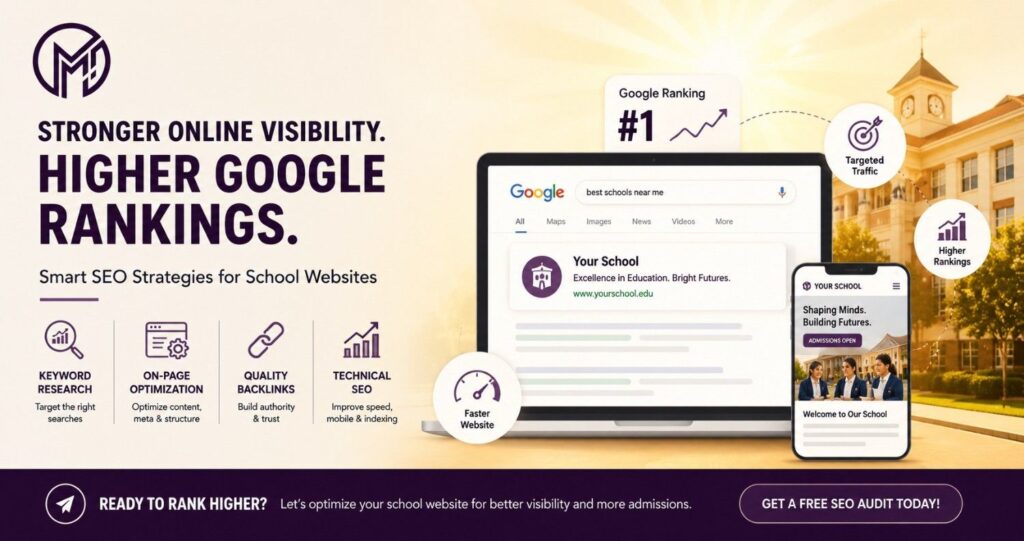
SEO for school websites means optimising your web pages so they appear at the top of Google search results when parents search for schools in your area. A well-optimised school website can generate consistent, free, high-intent traffic from parents who are actively looking to enroll their child.
Start with your Google Business Profile. This is the single most important SEO asset for a school because it controls what appears when parents search ‘best CBSE school near me’ or ‘top school in [your city]’. Ensure your profile has accurate address, phone number, school hours, photos of the campus, a link to your website, and at least 20 authentic parent reviews. Schools with well-maintained Google profiles rank in the Local Pack — the map section at the top of Google results — which receives up to 44 percent of all clicks for local searches.
On your website, every page should be optimised for a specific keyword. Your homepage should target ‘[School Name] [City]’. Create dedicated landing pages for each curriculum you offer — ‘CBSE School in [City]’, ‘Pre-Primary School Admissions [City]’, ‘IB School [City]’ — with unique, helpful content on each page. Avoid thin pages with just a logo and contact number; Google rewards detailed, informative pages that answer parents’ real questions.
Technical SEO matters too. Your school website must load in under three seconds on mobile devices. In India, most parents browse on Android smartphones with average 4G speeds, so a slow website means lost admissions. Use compressed images, a reliable hosting provider, and an SSL certificate (https). Internal linking — connecting your admissions page to your curriculum page to your fee structure page — also helps Google understand your site structure and boosts rankings across all pages.
Here is a quick comparison of the top SEO tools schools can use to improve their Google rankings:
Tool | Best For | Cost | Ideal For |
Google Business Profile | Local search ranking | Free | All schools |
Google Search Console | Tracking search performance | Free | All schools |
Ubersuggest / Semrush | Keyword research | Free / Paid | Schools with digital staff |
Yoast SEO (WordPress) | On-page optimisation | Free / Paid | WordPress school sites |
PageSpeed Insights | Website speed audit | Free | All schools |
Social Media Marketing for Schools to Boost Engagement
Social media marketing for schools is about building an ongoing relationship with parents, students, and the community — not just posting admission announcements. The schools that grow fastest on social media are those that treat their pages like a window into school life, not a billboard for promotions.
In India, Facebook and Instagram are the dominant platforms for reaching parents of school-age children. Facebook groups in local communities are particularly powerful — parents in Nagpur, Jaipur, Surat, and other cities frequently ask for school recommendations in neighbourhood groups, and an active, responsive school page gets mentioned more often. Instagram works brilliantly for visual content: photos of science fairs, sports day highlights, student art exhibitions, and teacher appreciation posts generate organic shares and saves that build brand recall.
Consistency beats frequency. Posting three times a week with genuine, quality content outperforms posting daily with generic quotes or filler graphics. Build a simple content calendar with content pillars: Monday for student achievement spotlights, Wednesday for curriculum insights or parenting tips, Friday for campus life and event previews. This rhythm keeps your audience engaged and signals to the algorithm that your page is active and relevant.
Reels and short-form video are the highest-reach content format on Instagram and Facebook in 2026. A 30-second reel showing a day in your school — morning assembly, a classroom activity, lunch break, a sports practice — can reach thousands of local parents organically without any paid spend. Schools that invest in even basic smartphone video content consistently outperform those relying only on designed graphics.
How Can Schools Use Social Media for Admissions?
Schools can use social media for admissions by running targeted parent-facing ad campaigns, showcasing academic results and co-curricular achievements, collecting inquiries through lead forms, and building trust through consistent, authentic content that answers parents’ top concerns.
The most direct way to convert social media followers into admissions inquiries is through Facebook and Instagram Lead Ads. These ads show to parents in a specific pin code, age group, or interest category and contain a built-in form that auto-fills the parent’s contact details. The friction is minimal, which results in significantly higher inquiry volume compared to driving traffic to a website. A well-targeted lead ad campaign with a budget of Rs. 5,000 to Rs. 15,000 per month can generate 50 to 150 qualified inquiries for a school in a Tier-2 Indian city.
Use social proof aggressively. Parent testimonial videos — even 60-second phone recordings — are among the most trusted content types for school marketing. When a parent watches another parent talk about why they chose your school and how their child has thrived, it removes doubt more effectively than any brochure. Feature testimonials regularly, especially during the January to March admission season when parents are actively deciding.
Do not ignore WhatsApp as part of your social media strategy. Many Indian schools now have a dedicated WhatsApp channel where prospective parents opt in to receive updates, event invitations, and admission reminders. WhatsApp broadcasts have open rates above 90 percent — far higher than email — making it one of the most effective tools for nurturing leads through the admissions funnel. Pair this with a responsive follow-up system and your conversion rate from inquiry to enrollment can improve significantly.
What is the Best Marketing Plan for Schools?
The best marketing plan for a school combines local SEO for organic visibility, targeted social media ads for lead generation, content marketing for trust-building, and a structured WhatsApp or email follow-up system for lead nurturing — all executed consistently across a 12-month calendar aligned with the Indian admission season.
A strong school marketing plan starts with understanding your admission cycle. In India, the primary admission season runs from November to March, with peak decision-making happening in January and February. Your digital marketing efforts must be at maximum intensity during this window, supported by ongoing brand-building activity throughout the year so that when the season begins, your school is already top-of-mind in your area.
Here is a practical annual marketing plan framework for Indian schools: From April to August, focus on brand building — update your website, collect fresh testimonials, improve SEO, and post consistent social media content. From September to October, ramp up content production — publish blog posts targeting admission-related keywords, create video tours, and begin warming up your social media audience. From November to February, shift to lead generation — run paid ads, activate WhatsApp campaigns, host open house events, and follow up with every inquiry within 24 hours. March onwards, nurture confirmed admissions and gather feedback from new parents to improve next year’s marketing.
Budget allocation matters. For a school spending Rs. 1,00,000 annually on marketing, a sensible digital split might be: 35 percent on paid social media ads, 25 percent on Google Ads, 20 percent on content creation (videos and photography), 10 percent on SEO tools and website maintenance, and 10 percent on WhatsApp marketing tools. Adjust this based on your school’s specific needs, local competition, and available staff bandwidth to manage campaigns.
Step-by-Step School Marketing Funnel Strategy
A school marketing funnel is the journey a parent takes from first discovering your school online to completing the admission process. Understanding and optimising each stage of this funnel is what separates schools that get many inquiries but few conversions from schools that efficiently turn interest into enrollment.
Stage 1 — Awareness:
This is where parents first encounter your school. It could be through a Google search, a Facebook ad, a friend’s WhatsApp message, or a YouTube video. Your goal at this stage is simply to make a strong first impression. A professional website, active social media, and a well-maintained Google Business Profile are your primary tools. Parents should be able to find your school name, location, curriculum, and key differentiators within seconds of landing on any of your digital properties.
Stage 2 — Consideration:
The parent is now comparing your school with two or three alternatives. They will read reviews, watch your videos, look at your fee structure, and perhaps visit your campus virtually. This is where content marketing wins. A detailed admissions page, a virtual tour video, faculty introduction videos, student achievement posts, and parent testimonials all reduce doubt and build preference for your school. Respond quickly to every comment, DM, and WhatsApp message during this stage — speed signals professionalism.
Stage 3 — Conversion:
The parent decides to inquire. This is a critical moment. Your lead form should be simple (name, phone, child’s age, preferred class), your response time should be under two hours, and your admissions counsellor should be trained to have a warm, informative first conversation rather than an aggressive sales pitch. Follow up consistently via WhatsApp — three to five touchpoints over two weeks — sharing relevant content like fee structure PDFs, school achievement highlights, or an open house invitation.
Stage 4 — Enrollment and Advocacy:
Once the parent enrolls, your marketing does not stop. Happy parents become your most powerful marketing asset. Encourage Google reviews, ask for video testimonials, invite them to share school events on their personal social media. A structured referral programme — where existing parents earn small rewards for referring new families — can generate 15 to 25 percent of new admissions for well-run schools in India.
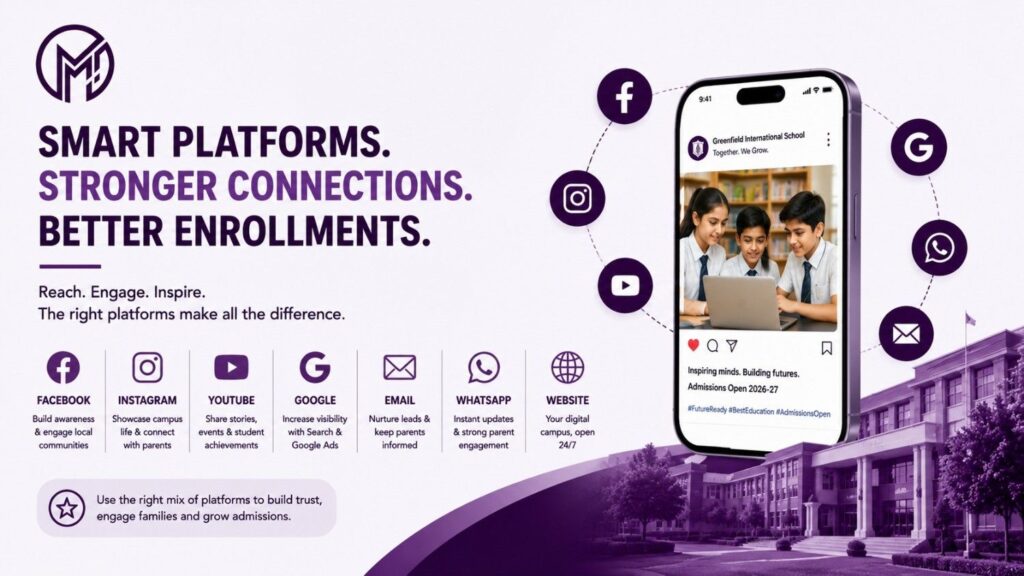
Best Platforms for School Marketing in India
Choosing the right platforms is as important as the quality of your content. Not every platform delivers equal value for school marketing in India, and spreading your efforts too thin leads to mediocre results everywhere. Focus on platforms where your target audience — parents between 28 and 45 years old — actually spends time.
Platform | Primary Use | Best Content Type | Estimated Cost (Monthly) | ROI for Schools |
Google Business Profile | Local SEO & Reviews | Photos, Posts, Reviews | Free | Very High |
Community building & Ads | Videos, Lead Ads, Events | Rs. 3,000 – 10,000 | High | |
Brand awareness & Reels | Reels, Stories, Carousels | Rs. 2,000 – 8,000 | High | |
YouTube | Long-form brand content | Campus tours, Testimonials | Free (production cost) | Medium-High |
Google Ads | High-intent search traffic | Search text ads | Rs. 5,000 – 20,000 | Very High |
WhatsApp Business | Lead nurturing & Follow-up | Broadcasts, Updates | Free – Rs. 1,500 | Very High |
Staff recruitment & B2B | Articles, School updates | Free | Low for admissions |
For most Indian schools, the highest-ROI combination is Google Business Profile (free, always-on local SEO), Facebook and Instagram for targeted parent ads during admission season, WhatsApp Business for lead follow-up, and Google Ads for capturing high-intent searches. YouTube is worth investing in for schools that can produce even basic .content — a well-made campus tour video continues to generate inquiries for years after it is published.

Common Mistakes Schools Make in Digital Marketing
Even schools that are investing in digital marketing often make avoidable mistakes that cost them inquiries and waste budget. Identifying and correcting these errors is one of the fastest ways to improve your school’s digital marketing performance.
The most common mistake is inconsistency. Schools run a social media campaign during admission season, then go completely silent for the rest of the year. Parents who follow your page and see months of inactivity question whether the school is well-managed. Consistent posting — even two or three times a week — builds the kind of ongoing visibility that makes your school the first one a parent thinks of when admission season arrives.
- Ignoring Google reviews:
Many schools never ask happy parents for Google reviews, then wonder why they rank below competitors with 50 or 100 reviews. Make requesting reviews a standard part of your onboarding process for new families.
- Poor website on mobile:
If your school website is not optimised for mobile viewing, you are losing more than 70 percent of potential inquiries. Test your website on an Android phone and fix any display or loading issues immediately. - No follow-up system:
Generating inquiries is only half the battle. Schools that do not follow up within 24 hours lose a significant proportion of warm leads to faster-responding competitors.
- Targeting too broadly with ads:
Running Facebook ads targeting ‘all of India’ for a school in Surat wastes budget on irrelevant audiences. Always geo-target within 10 to 20 kilometres of your school. - Only promotional content:
Parents unfollow pages that only post admission announcements. Balance every promotional post with four or five value-adding posts — parenting tips, student achievements, faculty spotlights, and campus life moments.
Finally, many schools make the mistake of measuring success by social media followers or website visits alone. The metrics that matter are inquiry volume, inquiry-to-visit conversion rate, and visit-to-enrollment conversion rate. Track these numbers monthly and your digital marketing strategy will continuously improve.
About the Author – Mansi Pitroda
Mansi Pitroda is a Digital Marketing Specialist with deep expertise in SEO, AEO, GEO, and SERP optimization strategies. She empowers businesses, students, and professionals with actionable insights into search visibility and AI-driven discovery. Through real-world experience and beginner-friendly content, Mansi helps brands rank higher, reach wider, and grow smarter in today’s evolving digital landscape.
FAQs
Google Search Ads, Meta (Facebook & Instagram), and YouTube are the top platforms for schools targeting parents in India. Google captures high-intent admission queries, while Meta enables demographic-based targeting by location and parental status. YouTube video ads build brand trust. WhatsApp Business further helps convert inquiries into confirmed school enrolments effectively.
Choose a social media management tool based on your school’s budget, team size, and platform needs. Buffer and Hootsuite suit small teams with scheduling and analytics. For Indian schools, tools offering Hindi-language support and WhatsApp integration add value. Prioritize tools with content calendars, approval workflows, and performance reporting dashboards for efficient management.
Post consistently across Instagram, Facebook, and YouTube using a content calendar. Share student achievements, campus events, faculty highlights, and admission updates. Use Reels and Stories for higher organic reach. Run targeted paid campaigns during admission season. Respond to comments promptly. Parent testimonials and virtual tour videos significantly boost trust and enrolment conversions.
A professional SEO audit for school websites evaluates technical health, on-page optimization, keyword rankings, backlink profile, and local SEO performance. Agencies typically charge ₹8,000–₹30,000 per audit in India. Request quotes from agencies experienced in education SEO. Audits identify issues affecting your school’s Google visibility and enrolment-related keyword rankings effectively.
Mailchimp, Brevo (formerly Sendinblue), and Zoho Campaigns are affordable email marketing tools ideal for Indian schools. They offer free or low-cost plans supporting automated admission drip campaigns, newsletters, and parent communication sequences. Look for tools with Hindi template support, easy contact segmentation, and DMARC compliance to ensure reliable email deliverability.
Small schools in India can use Canva for creative design, Google My Business for local visibility, Mailchimp for email campaigns, and Buffer for social scheduling — all with free or low-cost tiers. Meta Business Suite manages Facebook and Instagram free. These tools together deliver professional digital marketing at minimal cost, maximising admission-season results.
Leading Indian schools like Delhi Public School and international institutions like Ashoka University have grown admissions through targeted Google Ads, SEO-optimized landing pages, and parent-focused Facebook campaigns. Key success factors include clear CTAs, mobile-first landing pages, retargeting pixels, and authentic video content. Results commonly show 40–70% reduction in cost-per-lead within one year.
Several Indian agencies specialize in K-12 education marketing, including EduGrowth Digital, SchoolServ, and niche boutique firms offering admission campaigns, school SEO, and parent engagement strategies. Look for agencies with proven case studies, Google Partner or Meta Business Partner certifications, transparent pricing, and experience serving CBSE, ICSE, and IB-affiliated school segments specifically.