
Table of Contents
ToggleWhy Your Digital Marketing Agency Is Not Delivering Results
A digital marketing agency not delivering results when it operates without a clear strategy, uses vanity metrics to mask poor performance, misaligns campaigns with the client’s actual business goals, or lacks the expertise to execute SEO, paid ads, and content at a professional standard. In most cases, the problem is diagnosable and fixable — but only if you know what to look for.
You signed a contract, paid the retainer, and waited. Weeks turned into months. Your website traffic barely moved. Your leads — if any came through — were the wrong fit. Your Meta ads burned through budget with little to show for it. Your agency sends a monthly report filled with reach numbers and impression counts but nothing that connects to actual revenue. If this sounds familiar, you are not alone. This is one of the most common frustrations shared by business owners across India who have invested in digital marketing without seeing meaningful returns.
The painful truth is that India’s digital marketing industry has a significant quality gap. The rapid growth of social media and online business has led to a surge of agencies — from large established firms to individual freelancers billing themselves as full-service agencies — with widely varying levels of expertise, transparency, and genuine strategic capability. Many businesses, particularly in Tier-2 cities and owner-managed SMEs, find themselves locked into agency relationships that look professional on the surface but deliver nothing measurable beneath it.
This guide is written for business owners, marketing managers, and decision-makers who are questioning whether their current agency is genuinely working — and who want to make an informed, evidence-based decision about what to do next. Whether your problem is poor SEO performance, Facebook ads that do not convert, a social media presence that generates engagement but no inquiries, or simply a complete absence of transparent reporting, the sections below will help you diagnose the root cause and take action.
The Most Common Reasons Digital Marketing Fails
Digital marketing failure is almost always systematic rather than random. When campaigns consistently underperform over three months or more, there is a root cause — and it is usually one of three things: a strategy problem, an execution problem, or a measurement problem. Sometimes it is all three simultaneously. Understanding which category your situation falls into determines the right fix.
A strategy problem means the agency is executing the wrong activities with reasonable competence. Running Instagram reels for a B2B industrial supplier, for example, looks like active marketing but reaches the wrong audience entirely. An execution problem means the right strategy is broadly in place but the implementation is weak — poorly written ad copy, slow-loading landing pages, low-quality content, or unoptimised campaign settings that waste budget. A measurement problem means results may actually be reasonable but the agency is either not tracking them correctly or is tracking the wrong metrics and presenting them as success.
Research across the Indian digital marketing sector consistently shows that the majority of SME businesses that report dissatisfaction with their agency trace the problem back to the very beginning of the relationship: a vague brief, no agreed KPIs, no baseline metrics captured before the engagement started, and no 90-day performance milestone agreed upon contractually. Without these foundations, agencies can coast indefinitely on vanity metrics — followers, reach, impressions — while genuine business outcomes stagnate.
Poor Strategy and Lack of Clear KPIs
Poor strategy in digital marketing means running activities — posting content, running ads, doing SEO — without connecting those activities to specific, measurable business outcomes. Without clear KPIs (Key Performance Indicators) agreed from day one, neither the agency nor the client can objectively assess whether the work is succeeding or failing.
The clearest sign of a strategy problem is when your agency’s monthly report focuses entirely on activity metrics — posts published, ads run, emails sent — rather than outcome metrics — leads generated, cost per lead, website inquiries, phone calls tracked, revenue attributed to digital campaigns. Activity without outcome measurement is the digital marketing equivalent of running on a treadmill: a lot of effort, zero forward motion.
A professionally run agency defines KPIs before the first campaign launches. These KPIs are specific to the client’s business model and goals. For a coaching institute in Pune seeking admissions, the KPI is qualified inquiry calls per month and cost per inquiry. For a furniture manufacturer in Jodhpur selling to interior designers, the KPI is B2B leads through LinkedIn and Google Search. For a D2C skincare brand in Bengaluru, the KPI is ROAS (Return on Ad Spend) on Meta and Google Shopping. Generic KPIs like ‘increase brand awareness’ or ‘improve social media presence’ are not KPIs — they are strategy avoidance dressed in professional language.
💡 Expert Insight: Before your next agency review meeting, ask for a single document that lists: (1) the agreed KPIs for this engagement, (2) the baseline values captured before the engagement started, and (3) current performance against each KPI. If this document does not exist or cannot be produced, that is itself a finding.
Wrong Target Audience and Messaging
Reaching the wrong audience is arguably more damaging than reaching no one at all. When campaigns target broadly — by geography and age alone, without behavioural, interest, or intent filters — they generate impressions, clicks, and even form submissions from people who will never buy. This creates a false sense of activity while eroding budget and, worse, can make the business owner believe the product or service is the problem when the real issue is audience misalignment.
In India, this problem is particularly common in paid social media campaigns. Agencies often default to the widest possible audience targeting — ‘everyone between 25 and 55 in this city who is interested in general business’ — because broad targeting generates impressive reach and click numbers that look good in reports. But a real estate developer in Hyderabad needs to reach NRIs and high-net-worth individuals actively researching property investment, not every adult in the city. A premium Montessori school in Chennai needs to reach parents of children aged 2 to 5 years with household incomes above Rs. 15 lakh — not everyone who has ever interacted with parenting content.
Messaging failure is the companion problem to targeting failure. When audience targeting is correct but the ad creative, caption, or landing page copy speaks to the wrong pain point, the campaign still fails. Understanding your audience’s actual decision-making psychology — what they are afraid of, what they aspire to, what objections they hold — is essential to messaging that converts. Agencies that skip audience research and write generic ‘we are the best’ copy consistently underperform agencies that invest in understanding what specific words and promises resonate with the target segment.
🚩 Red Flag: If your agency has never conducted a formal audience persona session with you, never asked you for customer interview insights or sales call recordings, and has never revised campaign messaging based on performance data — your targeting and messaging are likely both off.
Weak SEO, Ads, or Funnel Execution
Even with the right strategy and the right target audience, poor technical execution destroys results. SEO, paid advertising, and conversion funnel design each require a specific skill set, ongoing attention, and continuous optimisation — they are not set-and-forget activities. Weak execution in any one of these areas can make an otherwise sound strategy fail.
Weak SEO execution is the most invisible problem because SEO results move slowly. An agency doing superficial SEO — publishing thin blog posts, building low-quality backlinks from irrelevant directories, making no technical improvements to the website — can spend 12 months looking busy without meaningfully improving Google rankings for any commercially valuable keyword. By the time the business owner realises the SEO is not working, a significant amount of retainer has been paid for work that will need to be corrected before real progress begins.
Weak ads execution is more immediately visible in the numbers. Signs include high click-through rates but near-zero conversion rates (indicating a landing page or offer problem), very high cost per click compared to industry averages (indicating poor Quality Score and ad relevance), or ad spend running out rapidly without conversions (indicating poor audience exclusions or bidding strategy). Any of these patterns, persisting for more than 30 days, indicates an execution problem that should be raised directly with the agency with a demand for a structured audit and remediation plan.
Funnel execution failure is perhaps the most overlooked. Many businesses have reasonable traffic from SEO or ads but convert poorly because the funnel has holes: a slow-loading landing page, a contact form with too many fields, no follow-up system for inquiries that do not become immediate conversions, or no remarketing campaign to re-engage visitors who showed interest but did not convert on the first visit. Learn more about auditing your conversion funnel in our section on fixing poor digital marketing results below.
Signs Your Digital Marketing Agency Is Underperforming
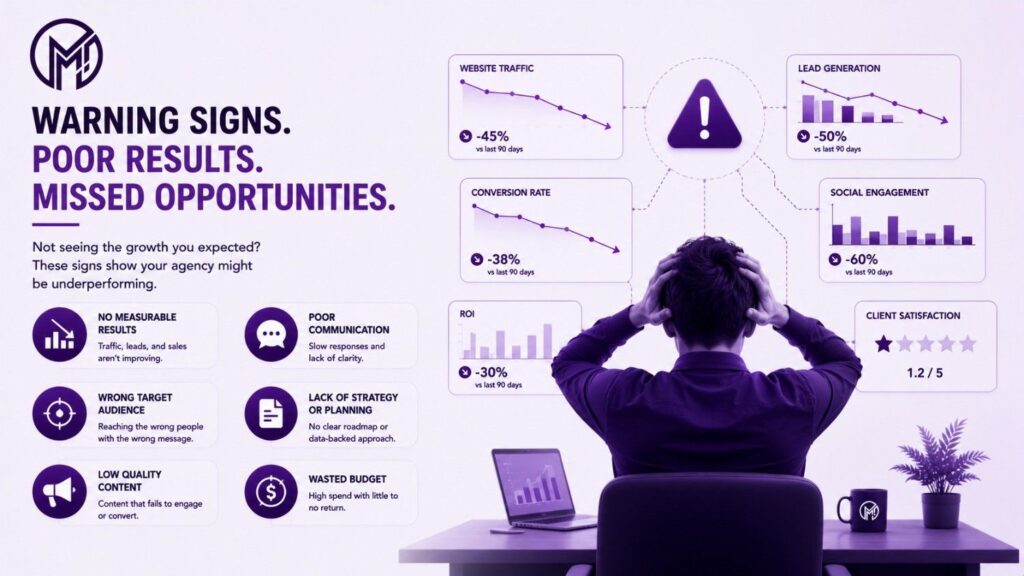
Your digital marketing agency is underperforming if you are consistently seeing low website traffic growth, minimal qualified leads, poor conversion rates from ads, inconsistent or vanity-metric-heavy reporting, and a lack of proactive strategic communication from the agency team. These signs — especially when they persist beyond three to four months — indicate a systematic problem, not a temporary adjustment period.
Most business owners wait too long to address agency underperformance. There is an understandable reluctance to acknowledge that a significant investment is not working — particularly when the agency relationship began with genuine optimism. But recognising the signs early and addressing them directly saves money, time, and the opportunity cost of results your competitors are gaining while your campaigns underdeliver.
The checklist below covers the most reliable warning signs across three categories: results, communication, and strategy. If you recognise three or more of these signs in your current agency relationship, it is time for a structured performance conversation — or a serious evaluation of whether the relationship should continue.
No Leads, Low Traffic, or Poor Conversion Rates
Quantifiable performance gaps are the clearest indicators of agency underperformance. While every business and campaign has a ramp-up period — typically 60 to 90 days for SEO and 30 to 45 days for paid ads — sustained underperformance beyond these windows is a red flag that requires immediate investigation rather than continued patience.
Metric | Healthy Benchmark (India) | Underperformance Signal | What It Likely Means |
Organic traffic growth | 10–20% MoM after 90 days of SEO | Flat or declining after 4 months | SEO strategy or execution problem |
Paid ad CTR (Search) | 3–6% for Google Search ads | Below 1.5% consistently | Poor ad copy or keyword-ad mismatch |
Landing page conversion rate | 3–8% for lead gen pages | Below 1% after optimisation | Landing page or offer problem |
Cost per lead (CPL) | Varies by industry; defined upfront | 2x+ above agreed target | Targeting, bidding, or offer problem |
Lead quality | 70%+ inquiries should be qualified | Mostly irrelevant or spam leads | Wrong audience or messaging |
ROAS (e-commerce) | Minimum 3x for sustainability | Below 1.5x after 60 days | Creative, product, or funnel issue |
Social media reach growth | Steady upward trend | Flat for 3+ months | Content strategy or algorithm issue |
Email open rate | 20–30% average | Below 10% consistently | List quality or subject line problem |
One particularly important pattern to watch is the disconnect between traffic and leads. If your website is receiving a growing number of visitors — as reported by Google Analytics — but inquiries, calls, or form submissions are not increasing proportionally, the problem is almost certainly in the conversion funnel, not the traffic acquisition strategy. This specific symptom points to landing page quality, offer clarity, call-to-action placement, or form design as the likely culprits.
🚩 Red Flag: If your agency is reporting growing ‘reach’, ‘impressions’, and ‘engagement’ every month but cannot tell you how many qualified leads or calls these activities generated, they are optimising for metrics that make their reports look good — not for metrics that grow your business.
Lack of Transparency and Reporting
Transparency in agency reporting is not a courtesy — it is a professional standard. A well-run digital marketing agency should provide clear, accurate, and actionable performance reports every month, presented in language the business owner can understand without a marketing degree. These reports should connect every activity directly to a measurable outcome, and they should honestly acknowledge what is not working alongside what is.
The most common transparency failures in Indian digital marketing agencies include: sending templated reports with the same positive framing every month regardless of actual performance; presenting reach and follower counts as primary success metrics while burying conversion data in footnotes; using technical jargon deliberately to make it difficult for the client to assess performance independently; and delaying or avoiding monthly review calls when results are poor.
The gold standard of transparent agency reporting includes: a clear dashboard showing agreed KPIs versus actual performance this month; a trend chart showing month-over-month progression; a breakdown of ad spend by campaign with cost per lead for each; organic traffic data from Google Search Console showing which keywords are driving visits; and a frank commentary section identifying what the agency will do differently next month to address any underperforming areas.
⚠️ Warning: Never accept a report that does not include access to the underlying data. Your agency should give you view access to your own Google Ads account, Meta Business Manager, and Google Analytics — not just screenshots of selected metrics. If they refuse to share access to accounts running on your budget, that is a serious professional concern.
Ask your agency one simple question: ‘Can you show me exactly how many leads came from digital marketing this month, what each of them cost, and what percentage converted into paying customers or qualified opportunities?’ A strong agency will answer this immediately and precisely. A weak or evasive response to this question tells you everything you need to know about the reporting quality you have been receiving.
How to Fix Poor Digital Marketing Results Quickly
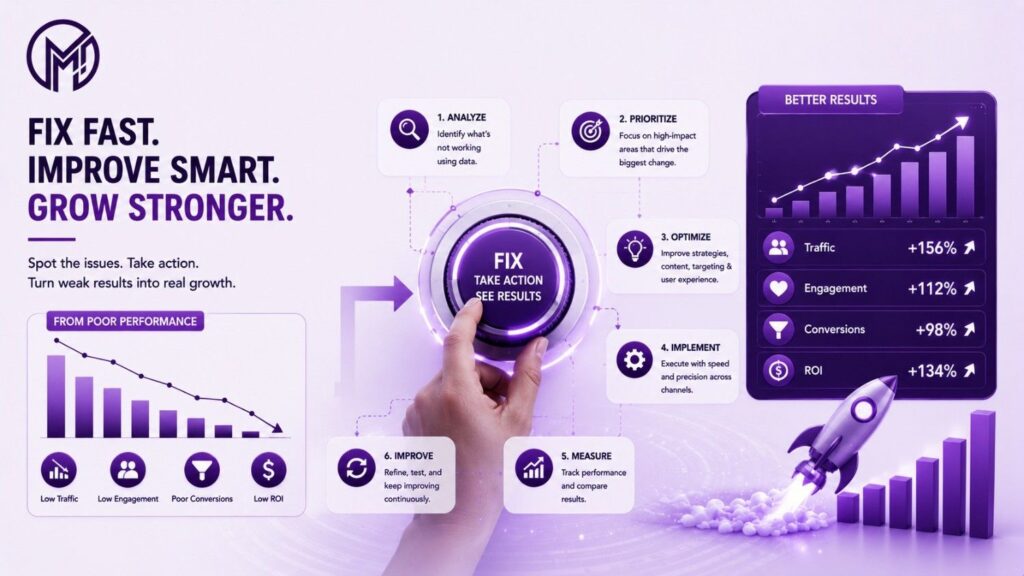
To fix poor digital marketing results, start with a structured audit of your current strategy, tracking, and campaign execution. Identify whether the problem is at the traffic level (not enough visitors), the conversion level (visitors not taking action), or the lead quality level (wrong people converting). Each problem has a different fix, and addressing the wrong layer wastes time and money.
Fixing poor digital marketing performance is a diagnostic process, not a guessing game. The businesses that recover fastest from underperforming campaigns are those that take a systematic, data-first approach to identifying the root cause before changing anything. Changing your agency, switching from SEO to ads, or redesigning your website — without first diagnosing the actual problem — often moves the pain rather than eliminating it.
Audit Your Current Marketing Strategy
A marketing strategy audit is a structured review of every component of your current digital marketing — what is being done, how well it is being done, what it is costing, and what measurable outcomes it is producing. An audit typically takes 5 to 10 hours of focused work across your website analytics, ad accounts, SEO data, and content performance.
Begin your audit with a website technical review. Use Google PageSpeed Insights to check your site’s load speed on mobile — if it loads in more than 3 seconds, you are losing a significant percentage of potential leads before they even see your content. Check Google Search Console for crawl errors, manual actions, or penalty notifications that may be suppressing your rankings. Review your sitemap, meta titles, and meta descriptions to ensure every key page is properly optimised and indexed.
Next, audit your ad accounts. If your agency runs Google Ads on your behalf, check the campaigns for these warning signs: are ads running on broad match keywords without negative keyword lists (a common budget waste issue)? Is the Quality Score for your main keywords below 5 (indicating poor ad-to-landing-page relevance)? Are campaigns set to run 24/7 without hour-of-day bid adjustments (wasting budget on low-conversion time windows)? Is remarketing active to re-engage visitors who did not convert? For Meta Ads, check audience overlap warnings, frequency caps on ad sets, and whether creative fatigue (declining CTR on aging ads) has been addressed.
- Check Google Analytics 4 for traffic sources: which channels are sending the most visitors and which are converting best.
- Review Google Search Console: which keywords bring visitors to your site, what is your average position, and what pages have high impressions but low clicks (indicating title or description optimisation opportunity).
- Audit your top 3 landing pages: load speed, mobile display, clarity of headline, visibility of contact form or call-to-action above the fold.
- Review your last 3 months of leads: where did they come from, what was the cost per lead per channel, and what percentage converted to revenue.
- Request your agency provide a full keyword ranking report, backlink profile summary, and ad performance breakdown for the last 90 days.
Key Metrics You Should Track (ROI, CPL, ROAS)
The three most important digital marketing metrics for any Indian business to track are: Cost per Lead (CPL) — what you spend to generate one qualified inquiry; Return on Ad Spend (ROAS) — revenue generated for every rupee spent on advertising; and overall digital marketing ROI — total revenue attributable to digital marketing divided by total digital marketing investment, expressed as a percentage.
Cost per Lead is the foundational metric for any lead-generation focused business — which includes most B2B companies, service businesses, coaching institutes, real estate developers, and professional service providers. Your target CPL should be calculated based on your average order value and your lead-to-customer conversion rate. If your average sale is Rs. 50,000 and you close 1 in 10 leads, you can afford to spend up to Rs. 5,000 per lead and still maintain a 10x return on that lead. Any CPL significantly above this threshold indicates either poor ad targeting, poor lead quality, or a combination of both.
ROAS is the primary metric for e-commerce and product-based businesses. A minimum sustainable ROAS of 3x means that for every Rs. 1 spent on advertising, Rs. 3 in revenue is generated. Below 2x ROAS, most e-commerce businesses are spending more on ads than they are profiting — particularly after factoring in product cost, shipping, and platform fees. Your agency should be tracking and reporting ROAS by campaign, by product category, and by platform — not just as a blended average.
Metric | What It Measures | Healthy Benchmark | How to Track |
CPL (Cost per Lead) | Cost to generate one inquiry | Varies by industry; define upfront | CRM + Google Ads / Meta Ads |
ROAS | Revenue per rupee of ad spend | 3x minimum for sustainability | Google Ads / Meta Ads reports |
CAC (Customer Acquisition Cost) | Total cost to acquire one customer | Less than 20% of LTV | CRM + total marketing spend |
Organic Traffic Growth | SEO performance indicator | 10–20% MoM after 3 months | Google Search Console |
Conversion Rate | % of visitors who take desired action | 3–8% for lead gen pages | Google Analytics 4 |
LTV:CAC Ratio | Long-term business health indicator | Minimum 3:1 ratio | CRM revenue data |
Keyword Rankings | SEO visibility for target terms | Page 1 for primary keywords | Semrush / Ahrefs |
Email Open Rate | Email campaign effectiveness | 20–30% average | Email platform analytics |
Optimize Campaigns for Better Performance
Once your audit identifies the specific performance gaps, campaign optimisation becomes a structured, prioritised process. Resist the temptation to change everything at once — simultaneous changes across multiple campaign variables make it impossible to identify which change produced which outcome.
For Google Search Ads, the highest-impact quick optimisations are: adding negative keywords to filter out irrelevant searches, improving ad copy to increase CTR (particularly the headline, which should include the primary keyword and a specific value proposition), and improving landing page relevance to the ad’s promise — which simultaneously improves Quality Score, reduces cost per click, and increases conversion rate. These three changes together typically reduce CPL by 20 to 40 percent within 30 days.
For Meta Ads, quick-win optimisations include: refreshing creative every 2 to 3 weeks to combat ad fatigue (falling CTR on aging creatives is the most common cause of rising CPL over time), narrowing audience targeting to improve relevance rather than reach, and testing one new audience segment per week to discover better-performing segments. Video ad formats consistently outperform static image ads for engagement and conversion in the Indian market — if your agency is running only static creatives, switching to video is typically the single highest-ROI creative change available.
✅ Fix It: Implement one campaign optimisation per week, track results for 7 days before the next change, and document every change with the date, description, and measured impact. After 8 weeks of this process, you will have a data-backed picture of what works for your specific business — intelligence that is genuinely valuable regardless of which agency you work with.
When Should You Change Your Digital Marketing Agency?
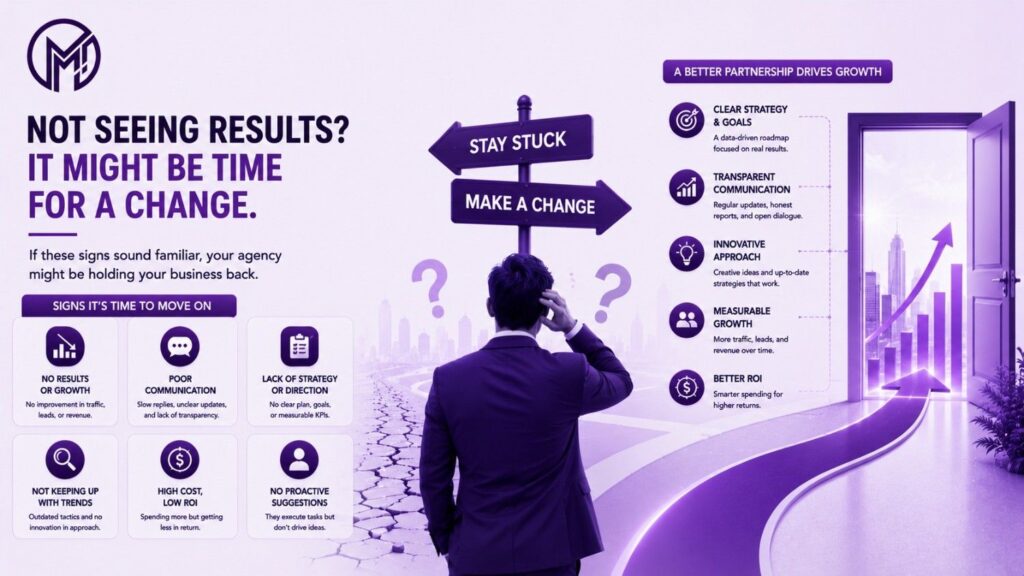
You should change your digital marketing agency when: KPIs have been missed for three or more consecutive months without a credible, data-backed recovery plan; the agency is unresponsive, defensive, or evasive when you request transparent performance data; your agreed reporting deliverables are consistently late or absent; or the agency lacks expertise in channels critical to your business growth — and shows no initiative to address this gap.
Changing agencies is not a decision to make reactively or emotionally — it should be the conclusion of a structured evaluation process. Many business owners switch agencies impulsively after a period of frustration, without clearly documenting what went wrong. This is a costly mistake because without understanding the root cause of the previous relationship’s failure, the new agency inherits the same undefined expectations, missing baselines, and ambiguous KPIs — and the cycle repeats.
The right time to evaluate a change is when you have had a direct, structured performance conversation with your current agency — presented them with the data from your audit, clearly stated the specific metrics that are not meeting agreed standards, and given them a defined 60-day recovery window with explicit milestones. If the agency is unable or unwilling to engage constructively with this process — if they deflect, over-promise without specifics, or become defensive rather than analytical — that is the most reliable signal that the relationship cannot be salvaged.
Red Flags You Should Never Ignore
🚩 Red Flag: The agency does not provide access to your own Google Ads, Meta Ads, or Google Analytics accounts — only reports and screenshots. This means the accounts may not exist as described, or the agency is hiding poor performance behind curated data.
🚩 Red Flag: Your agency ‘owns’ your website, domain, social media pages, or ad accounts and will not transfer them if you exit the relationship. Any professional agency works within your owned assets. Content, accounts, and platforms built using your budget belong to you.
🚩 Red Flag: Monthly reports are consistently delivered late, are formatted identically month after month regardless of results, or cannot answer the question ‘how many leads did we generate and what did each one cost?’
🚩 Red Flag: The agency has been running the same ad creatives for more than 8 weeks without refreshing. Ad fatigue is a real performance killer, and a competent agency rotates creatives proactively.
🚩 Red Flag: When performance issues are raised, the agency’s first response is to request more budget rather than to identify what is wrong with the current strategy. Additional budget on a broken strategy accelerates loss, not growth.
🚩 Red Flag: Your account is managed primarily by junior staff or interns, with senior strategists involved only for the initial pitch. Knowing who actually works on your account — and their experience level — is a legitimate question to ask.
🚩 Red Flag: The agency signs you to a long-term contract (12+ months) at the initial meeting without demonstrating results first. Confident, high-performing agencies offer 3 to 6 month initial engagements because they expect their results to earn the renewal.
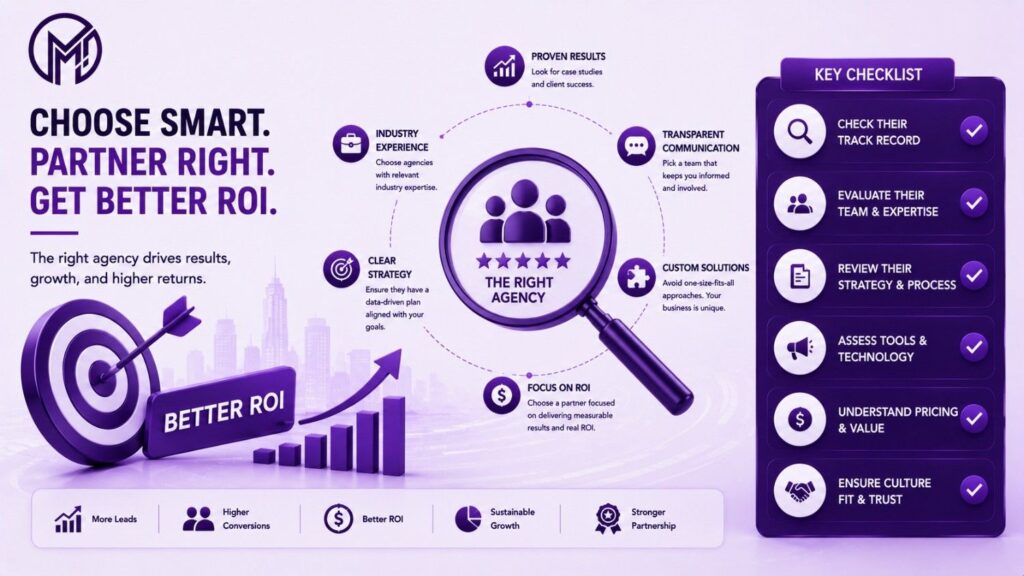
How to Choose the Right Digital Marketing Agency for Better ROI
To choose the right digital marketing agency for better ROI, evaluate candidates on five criteria: demonstrated results in your industry or a closely adjacent one, specific expertise in the channels most critical to your growth, transparent reporting methodology with access to live data, clear KPI-based engagement structure with defined milestones, and a team composition that includes senior practitioners — not just account managers — working on your account.
Choosing a new digital marketing agency after a disappointing experience requires a more rigorous evaluation process than most business owners apply. The temptation is to choose based on the quality of the sales presentation, the impressiveness of the agency’s own social media, or the attractiveness of their pricing. None of these factors reliably predicts whether the agency will deliver results for your specific business, in your specific market, through the specific channels you need.
The evaluation framework that consistently identifies high-quality agencies has three stages. First, request a written response to a detailed brief — your business goals, your current challenges, your budget, and your timeline. How an agency responds to a detailed brief reveals their thinking quality, their strategic depth, and how carefully they actually read what you sent. Second, ask for case studies from clients in your industry or business model type — not testimonials or logo lists, but documented campaign results with specific numbers. Third, conduct a structured question session with the team who will actually work on your account — not just the business development lead who brought you in. Want to speak directly with our strategy team? Get in touch today
Questions to Ask Before Hiring an Agency
The questions you ask during an agency evaluation reveal as much about the agency’s honesty and expertise as the answers themselves. A strong agency will answer performance questions specifically and confidently. A weak agency will deflect with generalities, speak in jargon, or over-promise without providing evidence. Here are the essential questions to ask every agency you seriously consider.
- Who exactly will work on my account — what are their names, roles, and experience levels? Will I have direct access to them?
- How will you report results? Can you show me an example of a real monthly report you provide to a current client?
- What KPIs will we agree on before the engagement starts, and what baseline data will you capture on day one?
- What happens if we miss agreed KPIs for two consecutive months? Is there a performance guarantee or review mechanism?
- Will all digital assets — website, ad accounts, social media pages, content — remain owned by my business throughout and after the engagement?
- How frequently will we have strategy review calls, and who from your team attends these calls?
- What are the three biggest challenges you anticipate in achieving our goals, and how do you plan to address them?
- Can you provide three client references I can speak with — ideally in a similar industry or business model to mine?
What Results Have You Delivered in My Industry?
Industry-specific results are the single most predictive indicator of whether an agency will succeed with your campaign. An agency that has run successful campaigns for a fashion e-commerce brand has learned the specific audience psychology, seasonal trends, creative formats, and funnel structure that convert in that category. This learning — built across multiple clients in the same space — gives them a head start that a generalist agency cannot replicate, regardless of their general competence.
When evaluating industry experience, look for documented case studies that include the campaign objective, the strategy deployed, the specific results achieved (in numbers, not percentages of improvement from an undisclosed baseline), the timeline over which results were achieved, and the client’s own testimony. Be appropriately sceptical of case studies that report only traffic growth without conversion data, or that present impressions and reach as the primary success metric without connecting them to leads or revenue.
If no agency you evaluate has direct experience in your specific industry, look for agencies with experience in an adjacent category with similar audience and sales cycle characteristics. A B2B manufacturer evaluating agencies might accept experience in other B2B service categories with complex, high-value sales cycles — even if the product category is different. The underlying strategic principles — long consideration cycles, relationship-based selling, LinkedIn and search-dominant channels — transfer meaningfully between categories.
💡 Expert Insight: Ask agencies to walk you through a failed campaign — what went wrong, how they identified the problem, and what they did to fix it. Agencies that can discuss failure intelligently and specifically are typically more trustworthy and more competent than those who present only success stories. Honest self-assessment is a strong signal of professional maturity.

How Do You Measure Success and ROI?
A strong agency measures success by comparing agreed KPIs — such as cost per lead, ROAS, or organic traffic growth — against baseline values captured before the engagement started. ROI is calculated as the revenue attributable to digital marketing activities divided by the total marketing investment, and this calculation should be available at any point in the engagement — not just at annual reviews.
The answer an agency gives to this question reveals their entire approach to accountability. Agencies that measure success by ‘improving brand awareness’ or ‘growing the community’ without connecting these to revenue-relevant outcomes are telling you they have no intention of being held accountable for business results. Agencies that answer with a specific measurement framework — here are the KPIs we will agree on, here is the tool we use to track them, here is the report format you will receive — are demonstrating the kind of operational rigour that reliably correlates with strong performance.
ROI measurement in digital marketing requires attribution — connecting specific marketing activities to specific revenue outcomes. For lead generation businesses, this requires a CRM that tracks inquiries from source to close. For e-commerce businesses, it requires proper conversion tracking in Google Ads and Meta Ads, connected to actual order revenue. If your current or prospective agency cannot explain their attribution model clearly — how they know which marketing activity produced which result — their ROI claims are not credible, regardless of how impressive the numbers look.
Finally, insist on shared access to all tracking and analytics platforms from the first day of engagement. Your Google Analytics, Google Ads, Meta Business Manager, Google Search Console, and any other platform running campaigns on your behalf should have you as the primary account owner — with the agency as a manager. This ensures that if the relationship ends, you retain full access to your campaign history, your data, and your assets. Any agency that resists this arrangement should be disqualified from consideration immediately.
About the Author – Mansi Pitroda
Mansi Pitroda is a Digital Marketing Specialist with deep expertise in SEO, AEO, GEO, and SERP optimization strategies. She empowers businesses, students, and professionals with actionable insights into search visibility and AI-driven discovery. Through real-world experience and beginner-friendly content, Mansi helps brands rank higher, reach wider, and grow smarter in today’s evolving digital landscape.
FAQs
Your digital marketing agency may be underdelivering SEO results due to poor keyword strategy, lack of technical audits, thin content, or neglected backlink building. Misaligned expectations, inadequate reporting, and failure to adapt to Google algorithm updates are also common culprits. Request a detailed SEO audit and insist on monthly performance reviews with clear ranking benchmarks.
Businesses should track organic traffic growth, lead conversion rate, cost-per-acquisition, return on ad spend, keyword ranking improvements, bounce rate, and email open rates to evaluate agency effectiveness. Additionally, monitor social media engagement, content performance, and monthly qualified lead volume. These metrics together reveal whether the agency is genuinely contributing to business growth and revenue generation.
Google Analytics 4, SEMrush, Ahrefs, HubSpot, and Google Search Console are essential tools for measuring agency performance. Looker Studio creates unified performance dashboards. CallRail tracks lead attribution, while Meta Ads Manager and Google Ads provide paid campaign transparency. Agencies using these tools together offer clients complete visibility across SEO, paid, content, and social channels.
Key signs an outsourced marketing team is underperforming include missed deadlines, vague reporting, declining organic traffic, stagnant lead volume, and poor ad ROI. If the team avoids KPI discussions, provides generic content, or fails to adapt strategies after poor results, act immediately. Request a performance review, compare benchmarks against industry standards, and consider agency replacement.
To find a better digital marketing agency in India, evaluate portfolios on platforms like Clutch.co, Google, and Justdial. Look for verified client reviews, Google Partner or Meta Business Partner certifications, transparent pricing, and proven case studies in your industry. Request trial campaigns before long-term commitment. Top cities like Mumbai, Bengaluru, and Ahmedabad host highly capable digital agencies.
Before engaging any digital marketing agency, ask: What measurable results have you achieved for similar clients? How do you report campaign performance? What is your team structure? How do you handle algorithm changes? What are your contract exit terms? Who owns the assets created? These questions protect your investment and reveal whether the agency is genuinely results-driven.
The most effective digital marketing services for small businesses are local SEO, Google Business Profile optimization, Meta advertising, email marketing, and content marketing. These deliver measurable results within limited budgets. Local SEO drives foot traffic and calls, while Meta ads generate leads cost-effectively. Email marketing consistently delivers the highest ROI for small businesses across most industries.
Establish clear KPIs with external marketing partners by defining SMART goals during onboarding, aligning metrics with business revenue objectives, and setting realistic 90-day benchmarks. Document agreed KPIs in the contract. Schedule monthly performance reviews using shared dashboards. Include consequence clauses for consistent underperformance. Collaborative KPI-setting improves agency accountability and ensures marketing investment directly supports measurable business growth.
Digital marketing agencies commonly fail to generate leads due to weak audience targeting, poorly optimized landing pages, irrelevant ad creatives, absence of lead nurturing sequences, and inadequate conversion rate optimization. Agencies that ignore buyer journey mapping, skip A/B testing, or rely solely on vanity metrics consistently underdeliver on lead generation, ultimately failing client revenue expectations.
Recommended analytics dashboards for monitoring marketing ROI include Google Looker Studio, HubSpot Marketing Dashboard, Databox, Klipfolio, and AgencyAnalytics. These platforms consolidate data from Google Ads, Meta, SEMrush, and CRM tools into single unified views. AgencyAnalytics is especially popular among Indian digital agencies for client-facing reporting. Custom dashboards aligned to revenue KPIs deliver the clearest investment accountability.