
Table of Contents
ToggleWhat Are Viral Social Media Strategies and Why Do They Work in 2026?
Viral social media strategies are deliberate, research-backed plans that social media agencies use to create content designed to be widely shared, saved, and commented on. In 2026, these strategies combine audience psychology, platform algorithm intelligence, trend timing, and hook-first storytelling to generate organic reach far beyond what paid ads alone can achieve.
When most business owners hear the word ‘viral’, they picture lucky accidents — a dog video that somehow got 10 million views, or a tweet that exploded overnight. Professional social media agencies know better. Virality in 2026 is largely engineered, not accidental. The top agencies in India and globally approach content creation the same way a product team approaches a launch — with research, testing, structured frameworks, and real-time data feedback.
So why do viral social media strategies work so effectively right now? The answer lies in how platforms like Instagram, YouTube, and LinkedIn have evolved. In 2026, all major social algorithms heavily prioritise content that generates rapid engagement signals — shares, saves, comments, and watch time — within the first 30 to 90 minutes of posting. Content that earns these signals gets pushed to wider audiences for free. This means a well-crafted organic post can out-reach a paid campaign when it hits the right emotional or informational nerve with its initial audience.
For businesses and brands in India, this creates an enormous opportunity. Indian social media users are among the most engaged in the world — India has over 500 million active social media users, with Instagram and YouTube being the top platforms for content discovery among people aged 18 to 45. Brands that understand how to trigger shares, saves, and comments among this audience can achieve visibility that would cost lakhs of rupees in paid advertising — at a fraction of the cost.
Viral strategies also build compounding brand equity. A single high-performing post does not just generate one wave of attention; it attracts new followers, boosts your page’s authority in the algorithm, and increases the baseline reach of your future posts. This is why agencies invest in building repeatable viral content systems rather than chasing one-off moments. Learn more about how this system works in our step-by-step agency framework below.
How Do Social Media Agencies Create Viral Content? (Step-by-Step Framework)
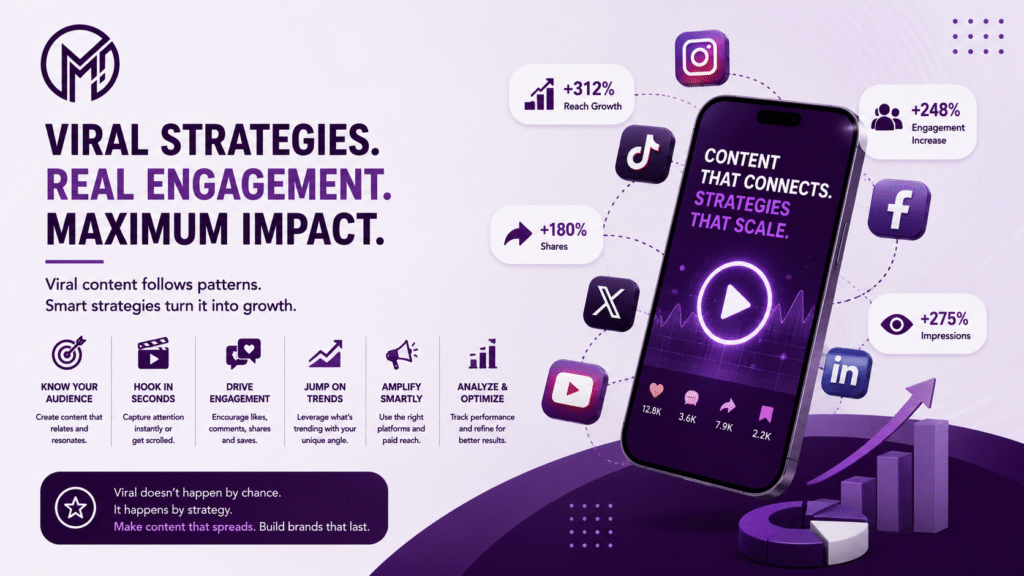
Professional social media agencies do not rely on inspiration or guesswork. They use a proven, repeatable content creation framework that systematically maximises the probability of a post going viral. This framework covers everything from initial research to post-publishing amplification, and it is the foundation of every high-performing social campaign run by top agencies in India and globally.
The most important thing to understand is that viral content creation is a process — not a moment of creativity. Agencies build teams, tools, and workflows around this process so that high-reach content is not a random achievement but a predictable output. Here is how the best agencies do it, broken into three core steps.
Step 1 – Audience Research and Trend Analysis
Every successful viral content campaign begins before a single word is written or frame is shot. Agencies start by conducting deep audience research to understand exactly who they are creating content for, what that audience already engages with, and what gaps exist in current content that their client can fill.
The tools agencies use for this include Meta Audience Insights for Facebook and Instagram demographics, Google Trends for search interest over time, Semrush or Ahrefs for keyword and topic research, and native platform analytics to identify which existing content pieces have highest save and share rates. On Instagram, the Explore page and Reels trending audio sections reveal what content formats are currently being amplified by the algorithm.
Agency Insight: Top agencies track competitor content performance weekly using tools like Social Blade and Phlanx. If a competitor’s reel hits 500K views, they reverse-engineer the hook, format, and topic to create a superior version for their client.
Trend analysis is equally critical. In 2026, trend windows on platforms like Instagram and YouTube Shorts are shorter than ever — a trend that is relevant today may be saturated within 72 hours. Agencies maintain real-time trend dashboards and move quickly when a relevant trend aligns with their client’s niche. Speed-to-trend is one of the clearest competitive advantages a professional agency has over in-house marketing teams.
Step 2 – Platform-Specific Content Planning
A mistake many brands make is creating one piece of content and posting it identically across all platforms. Professional agencies take the opposite approach — they plan content natively for each platform, understanding that what goes viral on Instagram Reels performs very differently on LinkedIn or YouTube Shorts.
Platform-specific planning means understanding each platform’s content format preferences, ideal video length, aspect ratio, caption style, and algorithmic triggers. On Instagram in 2026, Reels between 7 and 30 seconds with trending audio and on-screen text perform best for reach. On YouTube Shorts, vertical videos under 60 seconds with a clear educational or entertainment payoff outperform. On LinkedIn, long-form text posts with personal narrative and a strong opinion generate the most comments and reshares.
Platform | Best Format | Ideal Length | Top Trigger | Primary Audience (India) |
Reels + Carousels | 7–30 sec / 7–10 slides | Save + Share | 18–35 years | |
YouTube | Shorts + Long-form | <60 sec / 8–15 min | Watch time + CTR | 18–45 years |
Text Post + Video | 150–300 words / 1–2 min | Comments + Reshare | 25–45 years, professionals | |
Video + Reels | 30–90 sec | Shares + Reactions | 28–50 years | |
Twitter/X | Thread + Short video | 280 chars / <30 sec | Retweets + Quotes | 22–40 years |
Agencies also plan content in clusters — not individual posts. A single topic gets broken into multiple formats: a long-form YouTube video, three Instagram Reels repurposed from it, a LinkedIn text post with the key insight, and a Twitter/X thread. This cluster approach multiplies reach from one core idea while maintaining platform-native presentation.
Step 3 – Hook-Based Content Creation (First 3 Seconds Rule)
The first 3 seconds of any video or the first line of any caption determines whether a viewer stays or scrolls. Professional agencies write hooks before they write anything else. A strong hook creates immediate curiosity, challenges an assumption, or makes a bold promise — compelling the viewer to stop their scroll and watch.
This is the most technically skilled part of viral content creation, and it is where professional agencies deliver the most value over in-house teams. Writing a great hook is a craft that combines copywriting principles, psychological triggers, and platform-specific language patterns.
The most effective hook formulas agencies use in 2026 include: the contradiction hook (‘Everyone says X, but here is why that is wrong’), the number hook (‘5 things your social media agency is not telling you’), the curiosity gap hook (‘This one change tripled our client’s reach in 7 days’), and the bold statement hook (‘Most businesses waste 80 percent of their content budget on this mistake’). Each of these formats works because they create an information gap the viewer urgently wants to close.
Beyond the verbal hook, agencies also engineer visual hooks — the first frame of a reel must be high-contrast, visually surprising, or emotionally resonant. A talking-head reel that opens on a plain background and a slowly walking person to frame loses viewers in the first second. A reel that opens mid-action, with bold text on screen and movement, retains far more viewers through the critical first three seconds.
Proven Viral Content Strategies Used by Top Social Media Agencies
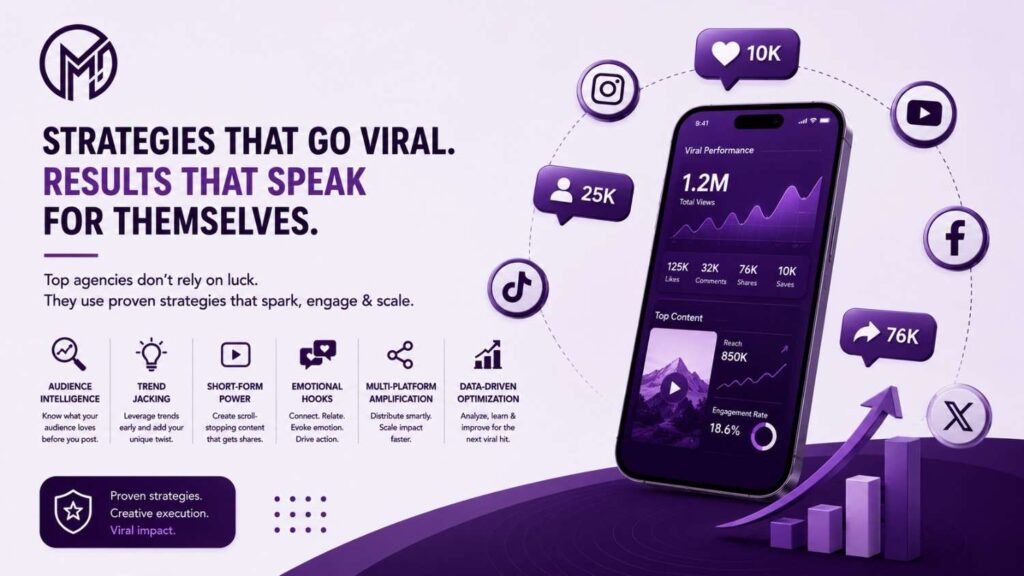
Beyond the three-step creation framework, top agencies deploy specific strategic approaches that consistently produce high-reach content across verticals. These strategies are not guesswork — they are built on observable patterns in content performance data and deep understanding of how social media users make decisions about what to share.
Data Driven Content Strategy
The most successful social media agencies in India are obsessively data-driven. Before publishing any piece of content, they analyse historical performance data to answer three questions: What topics generate the most saves and shares on this account? What content formats generate the longest watch time? What posting times correlate with highest initial engagement velocity?
Agencies run content experiments systematically — testing two versions of a hook on the same topic, comparing video thumbnails, or alternating caption lengths. These A/B tests generate platform-specific data that replaces subjective creative decisions with evidence-based ones. Over time, this approach builds a proprietary understanding of what works for each specific audience, which is why agencies with six months or more of data consistently outperform those starting from scratch.
Pro Tip: Use Instagram’s native Insights to find your top-performing posts by ‘Reach’. Identify the 3 common elements — topic, format, hook style. Build your next 10 posts around those patterns before experimenting with new formats.
Data-driven strategy also means tracking competitor content at scale. Agencies monitor the top 5 to 10 accounts in their client’s niche weekly, noting which posts overperform relative to that account’s average. This competitive intelligence reveals content opportunities that the agency can execute better, faster, or with a unique angle.
Emotional & Shareable Content Psychology
Data tells you what is working. Psychology tells you why. The best viral content agencies understand that sharing is an emotional act, not a rational one. People share content that makes them feel something strong enough to want others to feel it too — whether that emotion is inspiration, laughter, surprise, anger, or recognition.
Research consistently shows that the emotions most likely to drive sharing are awe, amusement, anger, and anxiety. Content that makes people say ‘this is incredible’, ‘this is hilarious’, ‘this is outrageous’, or ‘this is exactly what I have been worried about’ generates far more shares than content that simply informs or entertains mildly. Agencies craft content briefs with an explicit ’emotion target’ — identifying the specific feeling they want the viewer to experience and ensuring every element of the content is designed to trigger it.
Identity-based sharing is another powerful psychological lever. People share content that says something about who they are or who they want to be. A marketing professional shares a LinkedIn post about leadership not just because it is insightful, but because sharing it signals their professional values to their network. A fitness enthusiast reshares a workout transformation reel because it aligns with their identity as someone committed to health. Agencies that understand this create content that is implicitly ‘I am the kind of person who resonates with this’ — which dramatically increases organic sharing rates.
Platform-Specific Viral Strategies (Instagram, YouTube, LinkedIn)
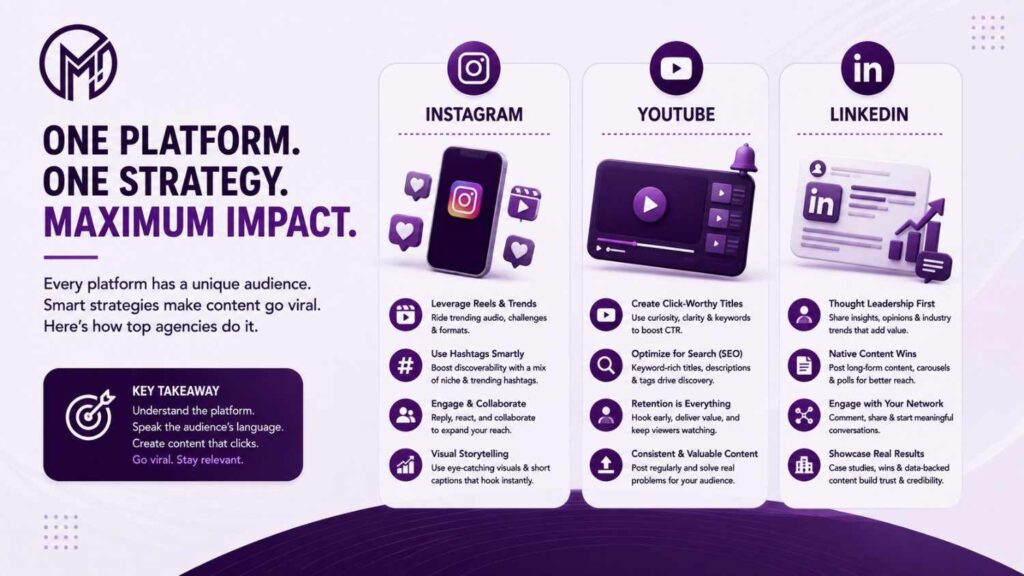
Each major platform has a distinct algorithm, user behaviour pattern, and content culture. A strategy that generates millions of views on YouTube Shorts may completely fail on LinkedIn. Understanding platform-specific virality is what separates agencies that deliver consistent results from those that recycle the same content everywhere and wonder why reach stagnates.
How to Go Viral on Instagram Reels
To go viral on Instagram Reels in 2026, create videos between 7 and 30 seconds with a strong visual hook in the first frame, use trending audio, add bold on-screen text, end with a save-worthy tip or surprise, and post during high-activity windows. Reels that earn saves within the first hour are pushed to the Explore page and non-follower feeds.
Instagram’s algorithm in 2026 heavily rewards the Save metric over Likes. A reel with 500 saves and 200 likes will dramatically outperform one with 2,000 likes and 50 saves in terms of reach. Agencies engineer save-worthy content by ensuring every reel delivers a takeaway the viewer wants to revisit — a practical tip, a checklist, a surprising fact, or an emotional moment. Adding a ‘Save this for later’ CTA within the reel itself increases save rates by 25 to 40 percent in most verticals.
Trending audio is the most underutilised viral accelerator on Instagram. When a sound is trending, Instagram actively pushes content using that audio to Explore and Reels feeds. Agencies monitor the Reels trending audio section daily and create at least two to three pieces of content per week using top-trending sounds. The key is finding audio that fits your content naturally — forcing irrelevant trending audio onto unrelated content feels jarring and decreases watch time.
A well-crafted carousel — particularly one that uses the ‘swipe to see the mistake most people make’ or ‘here are the 7 types of X — which are you?’ format — generates both saves and profile visits at high rates. Agencies create carousels with a strong cover slide (optimised as a thumbnail for the feed), value-dense middle slides, and a clear CTA on the final slide directing viewers to follow, save, or send to a friend.
YouTube Shorts Viral Strategy
YouTube Shorts surpassed 70 billion daily views globally in 2025, making it one of the highest-reach content surfaces in the world. For brands in India, YouTube Shorts offers a particularly strong opportunity because YouTube is India’s most-used video platform, with deep penetration in Tier-2 and Tier-3 cities where Instagram reach is more limited.
The core of a YouTube Shorts viral strategy is the loop — creating videos that are compelling enough that viewers watch them two or three times before swiping. YouTube’s algorithm measures re-watch rate as a key quality signal, and Shorts that loop naturally — where the end of the video connects back to the beginning — earn significantly higher algorithmic distribution. Agencies write Shorts scripts that end on a slight cliffhanger or a punchline that prompts the viewer to replay from the start.
Searchability is a unique advantage of YouTube Shorts over Instagram Reels. YouTube is a search engine as much as a social platform, and Shorts that target specific search queries — ‘how to X in 60 seconds’, ‘why your Y is failing’, ‘the truth about Z’ — accumulate long-tail views over weeks and months, unlike Instagram Reels whose reach peaks within 48 to 72 hours. Agencies optimise Shorts titles and descriptions with relevant keywords to build this compounding search traffic.
LinkedIn Content Virality for Brands
LinkedIn virality works on a fundamentally different mechanism than Instagram or YouTube. On LinkedIn, content spreads through professional networks, meaning the quality and relevance of your first-degree connections matters more than follower count. A post that earns 30 thoughtful comments from highly connected professionals in your industry can reach 100,000 people organically — far outpacing a post with 300 generic likes from a broad audience.
The content formats that go viral most consistently on LinkedIn in 2026 are personal narrative posts with a professional lesson, contrarian opinion posts that challenge industry conventional wisdom, and data-backed insight posts that share a surprising finding. All three formats share one quality: they invite response. LinkedIn’s algorithm heavily rewards comment activity, so agencies write posts that end with a direct question or a take bold enough that people feel compelled to agree or disagree.
For brands specifically, LinkedIn virality is best achieved through founder-led content rather than company page posts. Personal profiles consistently outreach brand pages by 5 to 10 times on LinkedIn. Agencies that help clients build founder-led LinkedIn presence — training founders or senior leaders to post authentic, value-driven content — generate far more organic reach than those managing sterile company page calendars.
What Makes Content Go Viral on Social Media? Key Factors Explained
Content goes viral on social media when it combines a strong emotional trigger, high relevance to a specific audience, a compelling hook that stops the scroll, a format optimised for the platform’s algorithm, and a reason to share — either because it reflects the sharer’s identity, provides genuine value, or creates a social currency moment.
Breaking this down into actionable factors: First, relatability. Content that makes a large group of people think ‘this is exactly my experience’ generates massive comment activity as people tag friends who will relate. Second, usefulness. Genuinely practical content — a 5-step process, a comparison table, a tool recommendation — earns saves, which is the signal most algorithms treat as the highest-quality engagement.
Third, novelty. Content that shows something the audience has never seen before, or frames a familiar idea in a completely new way, triggers the neurological reward response associated with discovery. This is why ‘I had no idea this was possible’ content consistently outperforms ‘here is the standard way to do this’ content. Fourth, social currency. People share content that makes them look smart, funny, caring, or culturally aware to their network. Agencies design content with the sharer’s social identity in mind — not just the creator’s message.
Fifth — and most technically important in 2026 — algorithmic fit. Even perfectly crafted content fails if it is not optimised for the platform’s current distribution mechanics. This means the right video length, the right aspect ratio, the right audio type, the right posting time, and the right caption structure for each specific platform. Agencies stay current with algorithm updates because the technical requirements for viral reach shift significantly every three to six months.
Best Viral Content Ideas for Brands and Small Businesses
You do not need a massive production budget or a celebrity endorsement to create viral content. Some of the highest-performing social media content in India in recent years has come from small businesses, solo founders, and local brands that understood their audience deeply and told authentic stories in compelling formats. Here are the most effective viral content ideas for brands and small businesses to use in 2026.
Viral Content Ideas for Instagram Reels 2026
- Before and after transformations: Whether you are a salon, a fitness coach, an interior designer, or a digital agency, before-and-after content showing real results generates massive engagement because it makes the value visible in seconds.
- ‘I tried X for 30 days’ content: Documenting a process, experiment, or challenge over time creates inherent narrative tension and gives audiences a reason to follow your account for updates.
- Myth-busting reels: ‘Stop believing this about [your industry]’ posts consistently go viral because they position you as an expert, challenge a widely held misconception, and make viewers feel they have gained exclusive insider knowledge.
- Behind-the-scenes content: Showing the real process behind your product or service — the kitchen, the design process, the packaging — builds trust and authenticity that polished marketing cannot replicate.
- ‘POV: You are a [customer type]’ reels: These use the viewer’s own perspective to create instant relatability, generating high comment and tag activity.
- Local language content: For businesses in India, creating reels in Hindi, Gujarati, Tamil, Marathi, or other regional languages can 5x engagement among local audiences compared to English-only content.
Creative Campaign Ideas That Boost Engagement
Beyond individual posts, well-structured campaign concepts can sustain viral momentum across weeks and drive both reach and conversions simultaneously. The best campaign ideas have a clear theme, a participation mechanic that encourages user-generated content, and a natural connection to your brand’s core message.
- Challenge campaigns: Create a simple, replicable challenge tied to your brand and use a branded hashtag. The key is making the challenge easy enough that many people can participate but entertaining enough that watching others do it is enjoyable.
- Customer story series: Feature a real customer’s transformation or success story every week. This generates word-of-mouth sharing because featured customers share the post to their own networks.
- Countdown campaigns: Build anticipation before a product launch, seasonal offer, or event with daily countdown content. Each post in the sequence gets reshared by those who missed earlier ones.
- ‘We asked 100 [target customers]’ campaigns: Collecting real survey data from your target audience and sharing the surprising results creates highly shareable infographic and reel content.
- Collab content: Partner with a complementary brand or a local micro-influencer (10K–100K followers) to co-create a reel or series. Both audiences see the content, doubling organic reach at zero additional cost.
Social Media Algorithm Tips to Increase Organic Reach
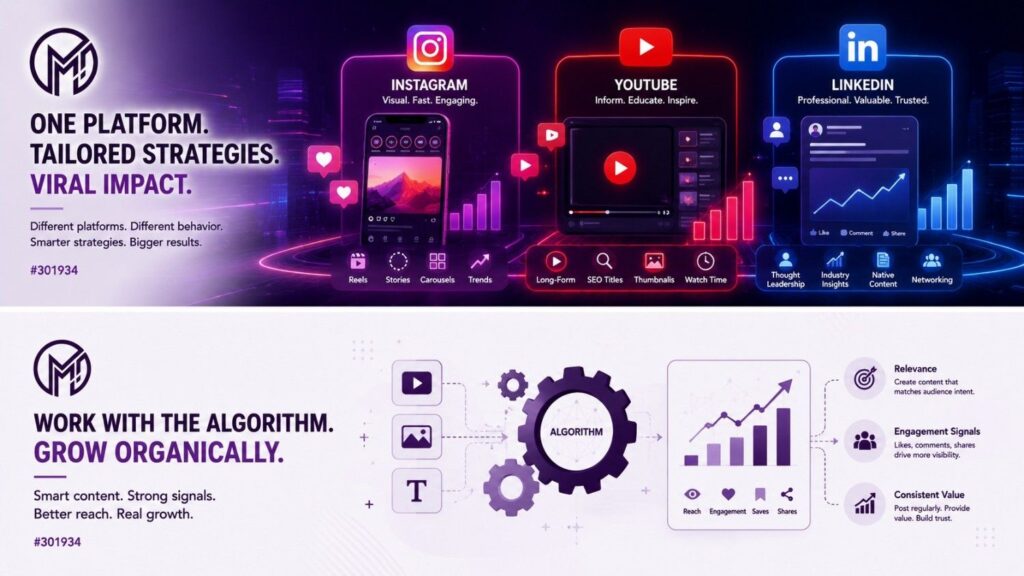
Understanding how social media algorithms work is not optional for brands serious about organic growth in 2026. Algorithms are the gatekeepers of reach — they decide whether your content is shown to 500 people or 500,000 people. Agencies invest significant time in algorithm research, platform changelog monitoring, and performance testing to stay ahead of these changes.
How Algorithms Work in 2026
In 2026, every major social platform uses a multi-stage distribution model for new content. When you publish a post, the algorithm first shows it to a small test audience — typically 3 to 10 percent of your followers — and measures engagement signals over the first 30 to 90 minutes. If the content earns strong signals (high watch time, save rate, comment rate, and share rate), the algorithm expands distribution to a wider audience. If engagement is weak, distribution is suppressed.
The specific signals each platform prioritises differ importantly. Instagram in 2026 weights saves and shares most heavily, treating them as indicators that content is worth bookmarking or worth telling a friend about — the highest forms of engagement. YouTube weights watch time and click-through rate from thumbnails. LinkedIn weights comment quality and connection relevance. Facebook weights reshares and reaction diversity. Knowing these platform-specific priorities allows agencies to design content that deliberately optimises for the highest-weighted signals.
Important: Engagement bait — asking followers to ‘Like this if you agree’ or ‘Comment YES if this helped’ — is actively penalised by most platform algorithms in 2026. Organic, unforced engagement signals are weighted far more heavily than prompted ones.
Posting Frequency and Timing Strategy
How often and when you post matters, but the quality-consistency balance is more important than raw posting frequency. An account that posts mediocre content daily will underperform an account that posts exceptional content four times a week. Agencies target a posting cadence that maintains content quality while building the consistency that algorithms reward.
For Instagram, the recommended agency-standard cadence in 2026 is 4 to 5 Reels per week plus 2 to 3 carousels or static posts. For YouTube, 3 to 5 Shorts per week plus one long-form video. For LinkedIn, 4 to 5 posts per week for personal profiles. These frequencies are high enough to build algorithmic momentum without sacrificing per-post quality.
Timing strategy varies by target audience, but broad patterns hold for Indian audiences. Instagram engagement peaks on weekdays between 7 AM to 9 AM, 12 PM to 2 PM, and 8 PM to 11 PM IST. LinkedIn is most active Tuesday through Thursday between 8 AM and 10 AM IST. YouTube watch time peaks on weekends between 2 PM and 8 PM IST. Use your account’s native analytics to find your specific audience’s active hours and align your posting schedule to those windows.
Real Examples of Viral Marketing Campaigns (Case Studies)
Looking at real-world examples of viral content campaigns helps clarify what separates high-impact strategies from mediocre ones. These case studies reflect patterns and approaches documented across the industry, demonstrating principles that any brand or agency can adapt.
Case Study 1 — Indian D2C Food Brand on Instagram: A homegrown healthy snack brand in Mumbai grew from 8,000 to 220,000 Instagram followers in 11 months using a consistent Reels strategy built around three content pillars: behind-the-scenes production videos (curiosity and trust), customer transformation stories (social proof), and ‘did you know’ nutrition myth-busting reels (educational virality). Their myth-busting series averaged 8 to 12 times their normal reach per reel because each video challenged a common misconception that viewers felt compelled to share with concerned family members. Their agency’s key insight was that health content spreads fastest when it empowers the sharer to look knowledgeable to people they care about.
Case Study 2 — B2B SaaS Company on LinkedIn: A Bengaluru-based HR technology company wanted to generate inbound leads through LinkedIn without paid ads. Their agency built a founder-led content strategy where the CEO posted personal narrative content — honest stories about building a company, failures, and lessons — three times per week. Within six months, the CEO’s profile grew from 2,000 to 35,000 followers. More importantly, the company attributed 40 percent of new demo requests to LinkedIn profile visits from the CEO’s posts. The viral moment came when one post about ‘the worst hiring decision we ever made’ earned 1,200 comments and was reshared by several prominent HR industry accounts.
Case Study 3 — Local Restaurant Chain, YouTube Shorts: A regional South Indian restaurant chain in Chennai used YouTube Shorts to showcase their kitchen process — chefs preparing signature dishes, the sourcing of fresh ingredients, and regional cooking techniques. These 45-second Shorts averaged 300,000 to 800,000 views each because they combined food ASMR (a consistently viral audio format), genuine cultural pride content, and practical cooking curiosity. The campaign cost approximately Rs. 40,000 in production over three months and generated a 60 percent increase in footfall at their outlets during the same period.
Common Mistakes That Prevent Content from Going Viral
Understanding what makes content go viral is only half the equation. Equally important is knowing what consistently prevents content from performing — because many brands unknowingly sabotage their own reach through avoidable errors. These mistakes are among the most common patterns agencies encounter when auditing underperforming social media accounts.
- Weak or absent hook: Starting a video with ‘Hey guys, welcome back to our channel’ or ‘So today we are going to talk about…’ wastes the most valuable real estate in social media content. Viewers decide to stay or scroll within 1 to 2 seconds. Open with your most compelling statement, visual, or question.
- Creating for yourself instead of your audience: Content that talks about what your brand wants to say — product features, company milestones, awards — almost never goes viral. Content that answers what your audience is already curious about, concerned by, or passionate about consistently outperforms. Start with audience pain points, not brand messages.
- Ignoring the save and share CTA: Most brands end content with ‘Follow us for more’ — a low-value CTA that almost no one acts on. Ending with ‘Save this for when you need it’ or ‘Send this to someone who needs to hear this’ directly increases the two highest-weighted algorithm signals on most platforms.
- Inconsistency: Posting five reels in one week then disappearing for three weeks sends a negative signal to algorithms and confuses audiences. Consistent posting — even at a lower frequency — builds compounding algorithmic momentum that sporadic bursts cannot replicate.
- Copying trends without relevance: Jumping on a trending audio or meme format that has no connection to your brand or audience creates cognitive dissonance. Trend participation must feel natural and brand-relevant, or it simply gets scrolled past by your existing audience while failing to attract new ones.
- Over-polishing: Heavily produced, advertisement-style videos consistently underperform raw, authentic-feeling content on social platforms. Audiences in 2026 are highly attuned to the difference between genuine and performed, and they reward genuine. Sometimes a phone-shot, single-take video from a real team member will outperform a Rs. 1 lakh production.
- No distribution strategy: Publishing great content without a plan to amplify it in the first hour is like throwing a party and forgetting to send invitations. Agencies have a distribution playbook — posting at optimal times, engaging with the first wave of comments immediately, sharing to Stories, and activating network amplification within the first 30 minutes.
Viral Social Media Strategies Answered (For Featured Snippets & AI Search)
These frequently asked questions address the most common queries about viral social media strategies, optimised for both human readers and AI search platforms like ChatGPT, Gemini, and Perplexity.
How long does it take for content to go viral?
Content can go viral within hours of posting if it immediately earns strong engagement signals — usually within the first 30 to 90 minutes. However, building the consistent content quality and algorithmic trust that makes virality achievable typically takes 3 to 6 months of strategic, high-quality posting. Most overnight viral moments are built on months of invisible preparation.
There is no guaranteed timeline for virality, and agencies who promise specific viral results are overpromising. What professional agencies can commit to is building the conditions that make viral performance increasingly likely over time — understanding your audience deeply, consistently creating high-quality content, optimising for platform algorithms, and testing different formats and hooks. Accounts that follow these principles for six or more months see significantly more high-reach content events than those that do not.
It is also worth noting that sustainable virality — the kind that builds a real business asset — is different from a one-time spike. A single viral video that brings 50,000 new followers who are not your target audience generates little business value. Consistent high-reach content that attracts the right audience, builds genuine community, and drives measurable inquiries or sales is the goal professional agencies work toward.
Can small businesses create viral content?
Yes, small businesses can absolutely create viral content — and many do more effectively than large corporations. Small businesses have authentic stories, direct customer relationships, and the agility to move on trends quickly. The most powerful small business viral content is founder-led, community-rooted, and genuinely useful or entertaining — none of which requires a large budget.
In fact, audiences on social media in 2026 are increasingly sceptical of polished, corporate-feeling content and are more likely to engage with content that feels real. A local bakery showing a chaotic morning rush, a solo consultant sharing an honest business lesson, or a small manufacturing business showing their production process can outperform content from brands spending ten times as much on production. The key advantage small businesses have is authenticity — and the key disadvantage is consistency. Agencies help small businesses build content systems that maintain consistent output without requiring the owner to be a full-time content creator.
Budget is less of a barrier than most small business owners believe. A smartphone with good lighting, a basic ring light (available for under Rs. 1,000 on Amazon India), and a free editing app like CapCut is sufficient to create professional-quality Reels and Shorts. The investment that matters most is time spent understanding your audience and crafting genuinely useful, emotionally resonant content — and that investment costs effort, not money.
What type of content performs best in 2026?
In 2026, the content formats that perform best across social media platforms are short-form vertical video (Instagram Reels, YouTube Shorts), educational carousels on Instagram, founder or personal narrative posts on LinkedIn, and authentic behind-the-scenes content. Video content overall generates 3 to 5 times higher reach than static images across all major platforms.
Within these formats, the content themes that consistently achieve the highest reach are: educational content that solves a real problem, transformation or before-and-after content, opinion or perspective content that challenges conventional thinking, relatable slice-of-life content for consumer brands, and data or research-backed insight content for B2B brands. The common thread across all high-performing content in 2026 is that it delivers a clear, immediate value to the viewer — whether that value is information, entertainment, inspiration, or validation.
Voice search and AI query optimisation are also shaping content strategy in 2026. As more users ask ChatGPT, Gemini, and Perplexity questions like ‘what is the best social media strategy for small businesses’, content that provides direct, structured answers to specific questions earns AI Overview citations and voice search results. Brands and agencies that create content in a Q&A format or with clear, direct answers to specific questions are positioning for the next wave of content discovery — one that goes beyond traditional Google search into AI-mediated information delivery.
FAQs
About the Author – Mansi Pitroda
Mansi Pitroda is a Digital Marketing Specialist with deep expertise in SEO, AEO, GEO, and SERP optimization strategies. She empowers businesses, students, and professionals with actionable insights into search visibility and AI-driven discovery. Through real-world experience and beginner-friendly content, Mansi helps brands rank higher, reach wider, and grow smarter in today’s evolving digital landscape.
Top social media agencies create viral content by combining data-driven storytelling, trend-jacking, and emotion-first hooks. They use A/B testing for creatives, collaborate with relevant micro-influencers, and post during peak engagement windows. Agencies prioritize short-form video, relatable narratives, and strong CTAs, while continuously optimizing based on real-time platform analytics and audience behavior insights.
Truly shareable content triggers strong emotions — humor, inspiration, surprise, or empathy. It must be visually compelling, platform-native, and immediately valuable to the viewer. Content that validates identities, sparks conversations, or challenges assumptions earns organic shares. Adding relatable captions, trending audio, and easily digestible formats significantly increases cross-platform shareability and organic content amplification.
Social media marketing firms boost virality for Indian brands by tapping into regional festivals, cricket events, Bollywood trends, and vernacular storytelling. They create content in Hindi and regional languages, partner with local influencers, and leverage WhatsApp, Instagram Reels, and YouTube Shorts. Cultural relevance combined with localized humor dramatically increases engagement and organic sharing among Indian audiences.
Agencies use tools like Google Trends, BuzzSumo, Sprout Social, and native platform analytics to identify trending topics in real time. Social listening monitors brand mentions and competitor activity. Teams track hashtag velocity, meme cycles, and news events daily. Rapid creative response within the first six hours of a trend maximizes viral campaign reach effectively.
Social media agencies recommend Instagram Reels, YouTube Shorts, and Moj for viral video campaigns in India. Globally, TikTok and LinkedIn Video lead for specific demographics. Instagram Reels offer the highest organic reach in 2026. YouTube Shorts benefit from Google’s search ecosystem. Agencies select platforms based on target audience age, content category, and campaign conversion objectives.
A viral content strategy workflow begins with audience research and trend analysis, followed by ideation and concept approval. Agencies then produce platform-specific creatives, schedule posts during peak hours, and launch with paid amplification if needed. Post-publishing, teams monitor engagement metrics hourly, iterate creatives based on performance, and document learnings for future campaign optimization cycles.
Affordable agencies specializing in viral content creation in India include Socialpilot, iDigitalise, and boutique digital studios offering packages from ₹10,000–₹40,000 monthly. They provide content calendars, Reels production, trend monitoring, and community management. Freelance platforms like Upwork also list specialists. Look for agencies with verified case studies, platform certifications, and transparent performance reporting structures.
Affordable agencies specializing in viral content creation in India include Socialpilot, iDigitalise, and boutique digital studios offering packages from ₹10,000–₹40,000 monthly. They provide content calendars, Reels production, trend monitoring, and community management. Freelance platforms like Upwork also list specialists. Look for agencies with verified case studies, platform certifications, and transparent performance reporting structures.
Notable examples include Zomato’s relatable meme campaigns, Amul’s topical cartoon posts, and boAt’s Gen Z influencer-led Reels strategy — all managed by expert social media agencies. Swiggy’s witty Twitter engagement and Fevicol’s culturally resonant video content also went viral organically. These campaigns succeeded through sharp cultural insight, consistent brand voice, and real-time trend responsiveness.
Agencies measure viral campaign success using KPIs including reach, impressions, shares, saves, comment sentiment, video completion rate, and follower growth. Tools like Sprout Social, Hootsuite Analytics, and Meta Business Suite track performance. Cost-per-engagement, brand mention volume, and website traffic spikes from social referrals are key secondary metrics. ROI is benchmarked against pre-campaign baseline data.