
Table of Contents
ToggleWhat Are AI Digital Marketing Strategies and Why They Matter in 2026
AI digital marketing strategies are data-driven, technology-powered approaches that use artificial intelligence to automate, optimise, and personalise every stage of a marketing campaign. In 2026, agencies in Ahmedabad and across India are using AI to predict customer behaviour, generate content at scale, improve ad targeting, and dramatically reduce cost per acquisition — giving them a measurable edge over competitors still relying on manual methods.
To understand why AI strategies matter so deeply in 2026, consider the sheer complexity of modern digital marketing. A single campaign now runs across multiple platforms — Google Search, Meta, YouTube, Instagram, WhatsApp — each with its own algorithm, audience behaviour, and content format. Managing this complexity manually, with spreadsheets and gut feel, results in slow decisions, wasted budget, and missed opportunities. AI changes this entirely. Machine learning models can process millions of data points in real time, identify patterns invisible to human analysts, and adjust campaigns automatically to maximise performance.
For digital marketing agencies in Ahmedabad, the adoption of AI strategies is no longer a competitive advantage — it is rapidly becoming a competitive necessity. Agencies that deploy AI tools for SEO, paid media, content creation, and customer targeting are completing in hours what previously took days, and they are delivering measurably superior results for clients. A local agency managing 10 clients with AI-augmented workflows can match the output quality of a 30-person non-AI team — a transformational efficiency gain that directly impacts profitability and scalability.
The businesses and brands in Gujarat’s commercial capital — from textile exporters and chemical manufacturers to e-commerce startups and real estate developers — are increasingly demanding AI-powered marketing from their agencies. They have seen competitors win with data, and they want the same. Agencies that can demonstrate a clear AI marketing methodology will win and retain more clients in this environment. This guide explains exactly how to build and deploy that methodology.
How AI Is Transforming Modern Marketing Agencies
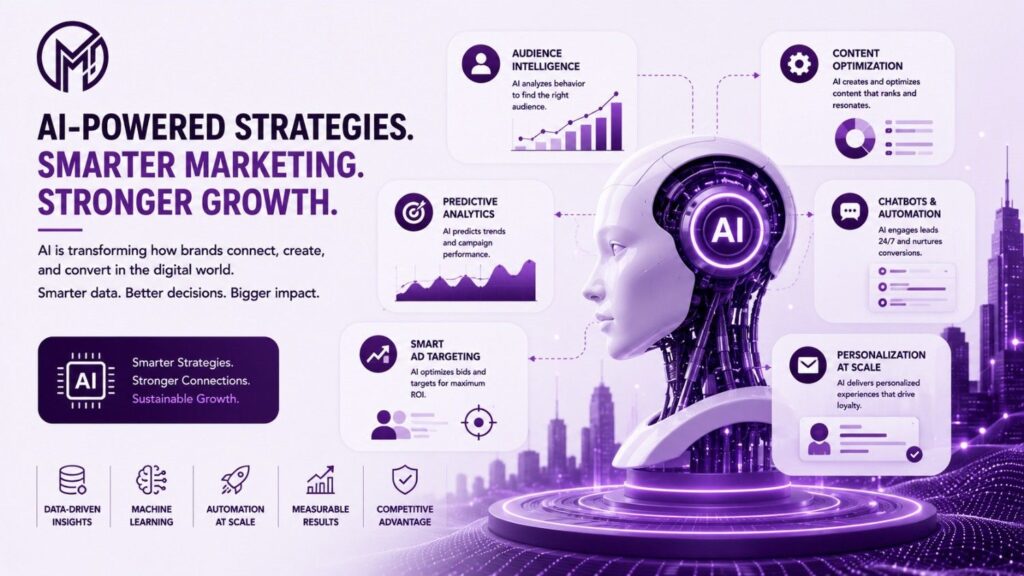
The transformation AI is bringing to marketing agencies is not incremental — it is structural. Traditional agency models were built around human expertise: strategists, copywriters, designers, media buyers, and analysts working in sequence. AI is collapsing this sequential model into a parallel, automated one where tools handle repetitive intelligence tasks and humans focus on strategy, creativity, and client relationships.
Consider content production. A mid-sized digital agency in Ahmedabad historically spent 15 to 20 hours per week creating blog posts, social captions, ad copy, and email newsletters for each client. With AI writing assistants and content generation platforms, that same volume of content can be drafted in 3 to 4 hours — freeing senior strategists to focus on content quality, brand voice refinement, and performance analysis instead of first-draft production.
In paid media, AI bidding systems on Google Ads and Meta Ads have already replaced manual bid management for sophisticated agencies. These systems — Google’s Smart Bidding, Meta’s Advantage+ — use machine learning to adjust bids in real time based on conversion probability signals that no human analyst could track at scale. Agencies that understand how to set up, train, and monitor these AI systems consistently achieve 20 to 40 percent lower cost per conversion than those running manual campaigns. The agency’s role shifts from bid manager to AI trainer and performance interpreter.
Agency Insight: Ahmedabad-based agencies managing clients in manufacturing, textiles, and real estate are finding that AI customer segmentation tools dramatically improve lead quality — by identifying which website visitors have the highest purchase intent and serving them targeted follow-up campaigns automatically.
Key Benefits of Using AI in Digital Marketing
The key benefits of using AI in digital marketing include faster campaign execution, more precise audience targeting, lower cost per lead, personalised content at scale, real-time performance optimisation, and predictive analytics that help agencies make proactive decisions instead of reactive ones.
Speed is the most immediately visible benefit. Tasks that previously required hours of manual work — keyword research, competitor analysis, ad copy variation testing, performance reporting — are completed in minutes with AI tools. This speed advantage allows agencies to launch campaigns faster, respond to market changes more quickly, and serve more clients without proportionally increasing headcount.
Precision targeting is the second major benefit. AI-powered audience modelling can identify micro-segments within a client’s customer base — identifying not just demographic characteristics but behavioural patterns, purchase cycle stages, content consumption habits, and intent signals. A real estate agency in Ahmedabad, for example, can use AI to identify which website visitors are likely first-time homebuyers versus investors, and serve each segment completely different messaging, offers, and landing pages — automatically.
Benefit | Traditional Marketing | AI-Powered Marketing | Impact for Agencies |
Speed | Days to weeks per campaign | Hours p–er campaign | 3–5x faster output |
Targeting | Demographic segments | Behavioural + intent micro-segments | Higher lead quality |
Content | Manual creation per piece | AI-assisted drafts + human edit | 70% time saving |
Optimisation | Weekly manual review | Real-time automated adjustments | 20–40% lower CPA |
Reporting | Manual data compilation | Automated dashboards | 5+ hours saved/week |
Personalisation | Limited by capacity | Dynamic 1:1 personalisation at scale | Higher conversion rate |
Top AI Marketing Agency Strategies to Dominate the Market
Market domination for a digital marketing agency in 2026 does not come from simply offering more services — it comes from delivering measurably superior, AI-powered results that competitors running traditional methods cannot match. The agencies that dominate their local market in Ahmedabad and nationally are those that have built proprietary AI workflows into every service they offer: SEO, paid media, content, social media, and CRM. Here are the top AI strategies these agencies are deploying.
AI-Powered Lead Generation Strategies for Agencies
AI has fundamentally changed how digital marketing agencies generate and qualify leads for their clients. The old model relied on broad-reach campaigns — run an ad, hope the right person clicks, send them to a generic landing page, and follow up manually. The AI model is far more surgical: identify high-intent prospects before they even raise their hand, serve them personalised touchpoints across channels, and route qualified leads to the sales team with predictive scoring attached.
Predictive lead scoring is one of the most powerful AI applications in lead generation. Platforms like HubSpot, Salesforce Einstein, and Leadsquared (popular among Indian agencies) use machine learning to analyse hundreds of data points — website behaviour, email engagement, company size, industry. Agencies that implement this for clients typically see their sales teams spend 60 to 70 percent more time on leads that actually convert, dramatically improving close rates without increasing headcount.
Conversational AI is another high-impact lead generation tool. AI chatbots deployed on client websites — built on platforms like Tidio, Intercom, or custom GPT-powered bots — can engage visitors 24 hours a day, qualify them with intelligent questions, capture contact details, and book demo appointments without human intervention. For a manufacturing company in the GIDC Vatva industrial area of Ahmedabad, a well-configured AI chatbot can capture and qualify 30 to 50 leads per month from website visitors that previously bounced without any contact.
Pro Tip: For B2B clients in Ahmedabad’s industrial sectors, combine LinkedIn Sales Navigator’s AI-powered prospecting with personalised outreach sequences built in tools like Apollo.io. This combination typically reduces the time from first contact to qualified meeting by 40 to 60 percent compared to cold email alone.
AI-Based Customer Targeting and Personalization Techniques
AI-based customer targeting uses machine learning to analyse customer data — purchase history, browsing behaviour, demographic signals, and engagement patterns — to predict which message, offer, and channel will convert each individual most effectively. In 2026, true 1:1 personalisation at scale is only possible through AI, and it is the single biggest conversion rate driver available to digital marketing agencies.
Dynamic content personalisation is the most impactful application. Using AI tools integrated with a client’s CRM and website platform, agencies can serve different homepage content, product recommendations, and CTAs to different visitor segments — automatically. A fashion e-commerce brand based in Ahmedabad’s textile corridor, for example, can show women’s ethnic wear to buyers who previously purchased salwar suits, party wear to those who browsed cocktail dresses, and budget options to price-sensitive segments — all on the same homepage, with no manual intervention.
Lookalike audience modelling, powered by Meta’s and Google’s AI systems, allows agencies to find new customers who share behavioural and demographic characteristics with a client’s best existing customers. By feeding the AI a list of top 1,000 existing customers, the platform identifies millions of similar users across its network and serves them targeted ads. This is significantly more effective than interest-based targeting because it is driven by actual purchase behaviour data rather than assumed interest signals.
Retargeting has also been elevated by AI. Standard pixel-based retargeting shows the same ad to everyone who visited a site. AI-powered retargeting segments retargeted visitors by their on-site behaviour — what pages they visited, how long they stayed, what products they viewed — and serves each micro-segment a different creative, message, and offer. An agency running AI retargeting for a real estate developer in SG Highway Ahmedabad might serve a virtual site tour video to high-engagement visitors, a price comparison ad to those who checked competitor pages, and a limited-time offer ad to those who began a contact form but did not submit.
The AI tools landscape for digital marketing agencies has matured significantly by 2026. The best agencies do not use one or two AI tools — they build an integrated technology stack where AI tools work together across the content, SEO, paid media, social, and analytics functions. Here is the most effective toolkit for agencies in India.
AI Tools for SEO, Content, and Automation
Category | Tool | Best Use Case | Pricing (Approx.) | Best For |
SEO Research | Semrush AI / Ahrefs | Keyword clustering, competitor gaps, SERP analysis | Rs. 8,000–15,000/mo | SEO agencies |
SEO Research | Surfer SEO | Content optimisation against top-ranking pages | Rs. 5,000–10,000/mo | Content teams |
Content AI | Claude / ChatGPT | First-draft blogs, ad copy, social captions | Free–Rs. 1,600/mo | All agencies |
Content AI | Jasper.ai | Brand-voice-consistent long-form content | Rs. 3,000–8,000/mo | Content-heavy agencies |
Image/Video AI | Canva AI / Adobe Firefly | Branded graphics, ad creatives at scale | Free–Rs. 2,500/mo | Design teams |
Video AI | Runway ML / InVideo AI | Short-form video generation and editing | Rs. 1,500–5,000/mo | Social media agencies |
Paid Media AI | Google Performance Max | Cross-channel automated ad campaigns | Budget-based | PPC agencies |
Email & CRM AI | HubSpot AI / Zoho CRM | Lead scoring, email personalisation, pipeline AI | Rs. 3,000–20,000/mo | Full-service agencies |
Analytics AI | Google Looker Studio | Automated reporting dashboards | Free | All agencies |
Social AI | Hootsuite AI / Buffer AI | Post scheduling, optimal time prediction | Rs. 2,000–6,000/mo | Social media teams |
Automation | Zapier / Make.com | Cross-tool workflow automation | Rs. 1,500–4,000/mo | All agencies |
Chatbot AI | Tidio / Intercom AI | Lead capture, customer support automation | Rs. 2,000–8,000/mo | Website-led agencies |
How to Choose the Right AI Marketing Tools for Your Agency
Choose AI marketing tools based on three criteria: your agency’s primary service focus (SEO, paid media, content, or full-service), your client base’s typical budget and industry, and your team’s technical capacity to implement and manage the tool. Start with two to three high-impact tools and build a full stack gradually — tool sprawl without integration creates more inefficiency than it solves.
The biggest mistake agencies make when adopting AI tools is purchasing too many simultaneously. When six new tools are introduced to a team at once, adoption is shallow for all of them — no one develops the deep expertise needed to extract maximum value from any single tool. Agencies that grow fastest with AI introduce one new tool at a time, run it for 60 to 90 days until the team is proficient, measure the ROI impact, and then add the next tool.
For a small agency in Ahmedabad managing 5 to 15 clients, a high-impact starter AI stack would be: Claude or ChatGPT for content drafting, Semrush for SEO research and tracking, Canva AI for creative production, Google Performance Max for paid campaigns, and Zapier for connecting these tools and automating repetitive workflows. This stack costs approximately Rs. 15,000 to 25,000 per month and can realistically save 40 to 60 hours of manual work weekly — a strong ROI even at small scale.
Agency Insight: Before committing to any annual AI tool subscription, test with a monthly plan for 60 days. Measure two things: hours saved per week and measurable improvement in a key client metric. If both are not positive, the tool is not the right fit for your workflows.
Step-by-Step Guide to Building an AI-Driven Marketing Strategy
Building an AI-driven marketing strategy is not a one-time event — it is a structured process that moves from goal clarity to tool selection to campaign execution to performance measurement and continuous improvement. Agencies that follow a disciplined build process avoid the most common pitfall: adopting AI tools without a clear strategic framework to guide them.
Setting Goals and Choosing AI Tools
Every AI-driven marketing strategy starts with the same question: what specific, measurable outcome do you need to achieve for this client? Not ‘more leads’ or ‘better social media’ — but a specific number. For example: increase qualified leads from 30 to 80 per month within 6 months, reduce cost per lead from Rs. 800 to Rs. 400, or grow organic search traffic by 150 percent in 12 months. Clear, quantified goals determine which AI tools are relevant and which are not.
- Define the primary business goal: lead volume, revenue, brand reach, or customer retention.
- Identify the marketing channels most likely to achieve that goal for this specific client and industry.
- Map AI tools to each chosen channel — content AI for SEO, bidding AI for PPC, personalisation AI for email.
- Audit the client’s existing data infrastructure: do they have a CRM, website analytics, customer purchase data? AI tools perform best when fed quality data.
- Set baseline metrics before any AI tool is deployed so you can measure the before-and-after impact accurately.
- Build the AI tool stack incrementally, starting with the tool that addresses the biggest bottleneck in current performance.
Goal setting also determines how you measure AI tool effectiveness. If the goal is lead volume, your primary measurement is inquiry submissions tracked in the CRM. If the goal is brand awareness, your measurement is reach, impressions, and share of voice in relevant search results. Aligning AI tools to specific, pre-defined metrics keeps the strategy focused and makes ROI reporting clear and credible to clients.
Automating Campaigns and Measuring Performance
With goals set and tools selected, the next phase is campaign automation — building the workflows and systems that allow AI to handle repetitive execution tasks while your team focuses on strategy and creative direction. This phase is where most of the time-saving value of AI is realised.
For content marketing automation, build a workflow where AI tools generate first drafts based on keyword briefs, a human editor refines the draft for brand voice and accuracy, and a scheduling tool automatically publishes at optimal times. This three-step workflow can produce eight to twelve SEO-optimised blog posts per month for a client — content that would have taken a full-time writer to produce manually.
For paid media, set up automated rules and AI bidding systems with clear performance guardrails. For example: if cost per lead exceeds target by 30 percent for three consecutive days, pause the ad set and trigger a Slack notification for the paid media manager to review. These automated rules prevent budget waste during off-hours and weekends when no human is monitoring campaigns.
Performance measurement in an AI-driven agency runs on automated dashboards, not weekly manual reports. Tools like Google Looker Studio, connected to Google Ads, Meta Ads, Google Search Console, and the client’s CRM, can generate real-time performance reports that update automatically. This saves 3 to 5 hours of reporting work per client per week and gives clients the transparency they increasingly expect. Learn more about setting up automated performance dashboards in our guide to AI tools for agencies.
Pro Tip: Build a weekly AI performance review ritual — 30 minutes reviewing automated dashboards, identifying anomalies, and adjusting strategy. Agencies that review AI-generated data weekly make better decisions than those that review monthly and miss early trend shifts.
Future of AI in Digital Marketing Agencies
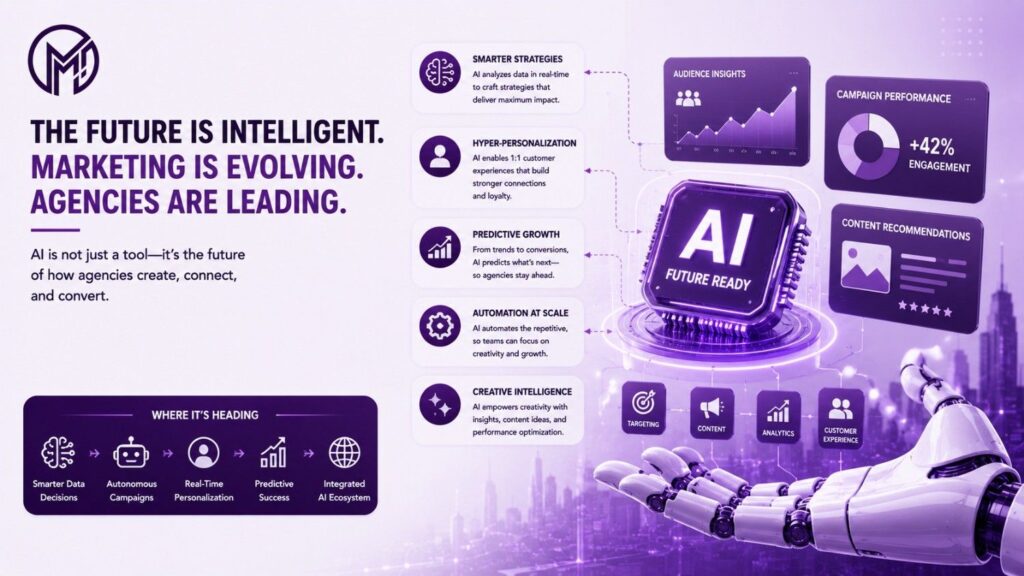
The pace of AI advancement in marketing technology is accelerating. The tools and strategies that represent the cutting edge today will be standard practice within 18 to 24 months, and new capabilities are emerging quarterly. Agencies that position themselves as AI-forward now — building team expertise, client case studies, and proprietary workflows — will be significantly harder to displace as AI becomes ubiquitous.
Emerging AI Marketing Trends for 2026 and Beyond
Agentic AI is the most significant emerging trend for marketing agencies. Unlike current AI tools that assist humans with specific tasks, agentic AI systems can execute multi-step marketing workflows autonomously — researching a target market, creating campaign assets, launching the campaign, monitoring performance, and adjusting it in real time without human intervention at each step. Early versions of this are already available in tools like Google’s AI Overviews for ads and Meta’s Advantage+ Shopping Campaigns.
Multimodal AI — systems that generate and analyse text, images, audio, and video together — is transforming content creation. In 2026, agencies are beginning to use multimodal AI to produce short-form video scripts, voiceovers, and rough cuts simultaneously, dramatically compressing video production timelines. What previously required a three-person production team for a full day can now be prototyped by one AI-assisted content strategist in two hours.
AI-powered search is reshaping SEO strategy. As Google’s AI Overviews, Bing Copilot, and dedicated AI search engines like Perplexity become primary information discovery tools for millions of users, agencies must develop AEO — Answer Engine Optimisation — alongside traditional SEO. This means creating content that AI search engines can extract, cite, and present as authoritative answers, not just content that ranks in the blue-link results. Structured data markup, direct question-answer formatting, and authoritative sourcing are all becoming more critical.
- Voice and conversational search: With smart speakers and AI assistants handling more queries, content must be written to answer spoken, natural-language questions — not just typed keyword strings.
- Hyper-personalised email at scale: AI tools in 2026 can generate a unique email for each individual recipient based on their CRM data — individual name, purchase history, browsing behaviour, and even predicted next need.
- Predictive content strategy: AI tools are beginning to predict which content topics will trend in specific industries 4 to 8 weeks in advance, allowing agencies to create content before competitors and capture early search traffic.
- AI-generated ad creatives: Platforms are moving toward fully AI-generated ad creative testing, where the system generates hundreds of visual and copy variations, tests them at scale, and automatically allocates budget to the best performers.
Common Mistakes to Avoid in AI Digital Marketing
As AI adoption accelerates among marketing agencies in Ahmedabad and across India, a predictable set of mistakes is emerging. These errors range from technical missteps to strategic misalignments, and they consistently prevent agencies from realising the full potential of their AI investments. Understanding these mistakes in advance saves significant time, budget, and client relationships.
Over-Automation Without Strategy
Over-automation in AI digital marketing occurs when agencies automate execution without first establishing a clear strategy, audience understanding, and brand voice framework. Automation amplifies what already exists — if the underlying strategy is weak or the audience targeting is wrong, AI will execute the wrong actions faster and at greater scale, multiplying the problem rather than solving it.
The most common form of over-automation is using AI content tools to produce high volumes of blog posts, social captions, or ad copy without proper editorial oversight. AI-generated content without human refinement is often factually generic, tonally inconsistent, and lacking the specific local insights and brand personality that differentiate a client in their market. Google’s helpful content system actively deprioritises thin, AI-generated content that provides no unique value — meaning an over-automated content strategy can actually damage a client’s search rankings.
Warning: Never publish AI-generated content without human review. AI tools can hallucinate facts, use incorrect industry-specific terminology, and miss local context. For clients in regulated industries — finance, healthcare, legal — always have a subject matter expert review AI-generated content before publishing.
Over-automation in paid media is another frequent error. Agencies that hand full control to Google Performance Max or Meta Advantage+ without carefully defining conversion goals, audience exclusions, and creative guidelines often end up with campaigns that spend budget efficiently but against the wrong audiences or with messages that do not reflect the brand. AI bidding systems are powerful, but they need human-defined guardrails to function correctly.
Ignoring Data Privacy and Ethics
As AI marketing becomes more powerful in its ability to track, analyse, and target individuals, data privacy and ethical usage become non-negotiable responsibilities for agencies. In India, the Digital Personal Data Protection Act (DPDPA) 2023 is now in active implementation, and businesses that collect, process, or use personal data for marketing — including through AI tools — must comply with its consent, purpose limitation, and data minimisation requirements.
For practical compliance, agencies must ensure that every AI tool they use — particularly those handling customer data for CRM integration, behavioural targeting, or personalisation — has clear data processing agreements and stores data in ways that comply with DPDPA requirements. Using a US-based AI CRM tool that stores Indian customer data on servers without adequate protections creates legal exposure for both the agency and its clients.
Beyond legal compliance, ethical AI marketing is increasingly a trust and reputation issue. Consumers in 2026 are more aware of how their data is used, and brands that deploy overtly surveillance-like targeting — serving ads that feel intrusive or invasive — suffer brand damage. The best agencies design AI targeting that is relevant without feeling creepy: using behavioural data to serve genuinely helpful content, not to track individuals across every digital surface they inhabit.
- Always obtain clear consent before using customer data in AI training or personalisation systems.
- Audit every AI tool in your stack for data storage location, encryption standards, and DPDPA compliance.
- Build opt-out mechanisms into all AI-powered communication flows — chatbots, email sequences, personalised ads.
- Never use AI to create fake reviews, fabricated testimonials, or misleading performance reports for clients.
How AI Helps Digital Marketing Agencies Grow Faster
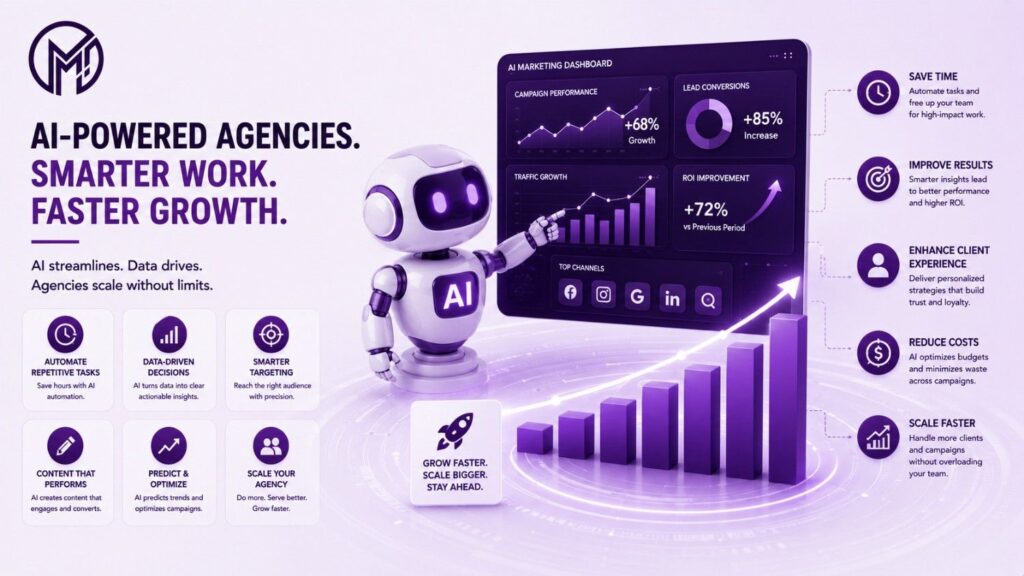
For digital marketing agencies in Ahmedabad, growth is constrained by two things: the capacity to serve more clients and the ability to deliver better results that justify premium pricing. AI directly addresses both constraints. By automating execution tasks, agencies increase capacity without proportionally increasing cost. By improving campaign performance through data intelligence, agencies can charge higher retainers and demonstrate measurable ROI that client relationships depend on.
Scaling Campaigns with Automation
The most direct path to agency growth through AI is operational scaling — the ability to manage more clients, more campaigns, and more content volume without hiring proportionally more people. A traditional agency that manages 10 clients at full capacity needs to double its team to take on 10 more. An AI-augmented agency can often take on 5 to 8 additional clients with the same team by automating the most time-intensive execution tasks.
Content production automation is typically where the largest capacity gains are achieved. An agency that previously spent 20 hours per client per month on blog writing, social content, and ad copy can reduce this to 8 to 10 hours using AI drafting tools — freeing 10 to 12 hours per client per month for higher-value strategic work or new client onboarding. At 10 clients, this represents 100 to 120 hours per month of recovered capacity — effectively adding two full-time equivalent team members without any additional salary cost.
Campaign automation for reporting, bid management, and performance monitoring compounds this capacity gain. When AI dashboards report automatically and AI bidding systems optimise continuously, account managers spend less time on maintenance and more time on strategy and client communication — the activities that drive renewals, upsells, and referrals.
Improving ROI with Predictive Analytics
Predictive analytics uses AI to analyse historical campaign data and forecast future performance, enabling agencies to allocate budget proactively to high-performing channels, identify declining campaigns before they waste significant spend, and make data-backed strategic recommendations to clients — replacing intuition-based decisions with evidence-based ones.
The practical application of predictive analytics for a digital marketing agency is budget optimisation. By analysing three to six months of historical campaign performance data, AI tools can identify which audience segments, creative formats, and channel combinations have the highest probability of converting at or below target cost. Budget allocation decisions driven by this analysis consistently outperform budget decisions made on experience and intuition alone.
Predictive analytics also enables proactive client communication — one of the most underrated drivers of client retention. When an AI analytics tool identifies that a client’s campaign performance is trending downward before it becomes a visible problem, the agency can contact the client proactively with analysis and a plan to address it. This transforms the agency’s relationship from reactive service provider to proactive strategic partner — a positioning shift that justifies higher retainers and dramatically improves renewal rates.
AI SEO Strategies for Agencies to Rank Higher on Google
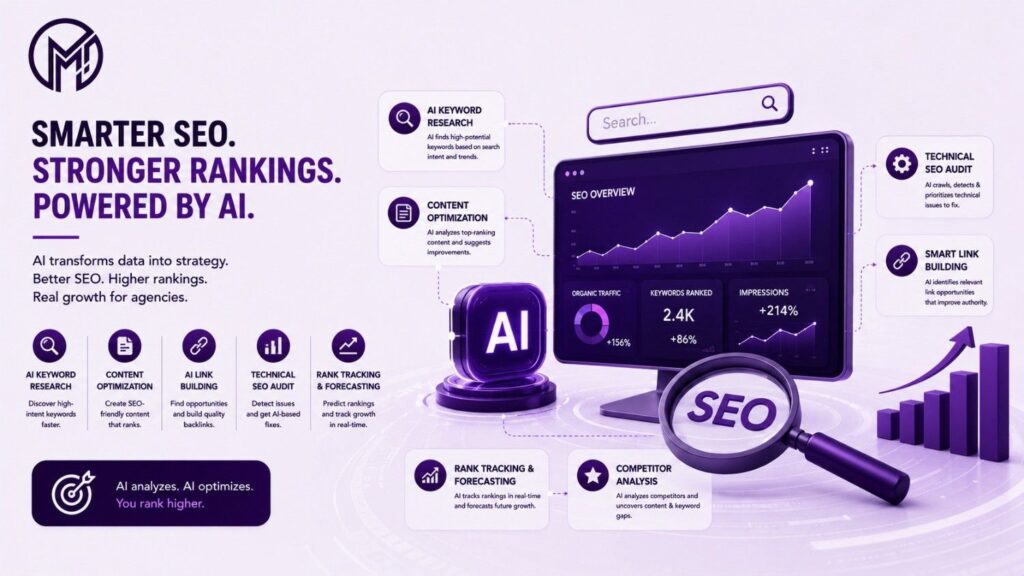
SEO is the service most transformed by AI in 2026. What used to require days of manual keyword research, competitor analysis, content brief writing, and performance tracking can now be completed in hours with the right AI SEO tools. For agencies in Ahmedabad, mastering AI-powered SEO creates a significant differentiation opportunity — delivering faster results and deeper insights than competitors relying on manual SEO processes.
Using AI for Keyword Research and Content Optimization
AI-powered keyword research goes far beyond simply finding keywords with high search volume and low competition. Modern AI SEO tools like Semrush, Ahrefs, and Surfer SEO use machine learning to cluster keywords by topical relevance, identify semantic relationships between related search terms, and reveal content gaps — topics that users are searching for that no page on your client’s site currently addresses.
Topical authority mapping is one of the most powerful AI SEO strategies in 2026. Rather than optimising individual pages for individual keywords, AI tools help agencies build comprehensive content clusters — a pillar page covering the broad topic, supported by 8 to 15 closely related articles covering specific subtopics. This cluster approach signals to Google that the client’s website is a comprehensive, authoritative resource on the topic — leading to higher rankings across the entire cluster, not just for the pillar keyword.
Content optimisation tools like Surfer SEO and Clearscope analyse the top 20 ranking pages for any target keyword and identify exactly which semantic terms, question formats, heading structures, and content lengths correlate with top rankings. Agencies using these tools can brief and optimise content with precise, data-backed recommendations rather than editorial guesswork — and the results are consistently superior. Clients see first-page rankings 40 to 60 percent faster than with manually optimised content.
Pro Tip: For clients in Gujarati or Hindi-speaking markets in Ahmedabad, AI keyword tools increasingly support regional language keyword research. Building content in both English and regional language versions targets completely different search audiences and can double the organic traffic opportunity for local businesses.
AI for Technical SEO and SERP Analysis
Technical SEO — identifying and fixing the structural issues that prevent a website from ranking despite good content — has historically been one of the most time-intensive SEO disciplines. AI-powered site audit tools like Screaming Frog with AI integrations, Semrush Site Audit, and DeepCrawl can analyse thousands of pages in minutes, prioritise issues by their estimated impact on rankings, and in some cases generate automated fix recommendations that developers can implement directly.
SERP feature analysis is another area where AI delivers significant value. Google’s search results pages in 2026 include Featured Snippets, AI Overviews, People Also Ask boxes, local packs, image carousels, and video results — each representing an additional ranking opportunity beyond the standard blue links. AI SERP analysis tools identify which of these features appear for a client’s target keywords, what content format and structure is required to win each feature type, and which features represent the highest click-through opportunity.
For agencies targeting the AI Overview — Google’s AI-generated answer that appears above organic results for many informational queries — the content strategy requirement is precise: write clear, direct, structured answers to specific questions, supported by credible data and organised with HTML heading hierarchy that AI systems can parse easily. This is simultaneously good practice for traditional featured snippets and for AI search engines like Gemini and Perplexity, making it a high-leverage content investment for any SEO-focused agency.
Conclusion: Building a Market-Dominating AI Marketing Agency
The opportunity for digital marketing agencies in Ahmedabad to dominate their market using AI strategies has never been clearer — or more time-sensitive. AI tools and methodologies are available, proven, and increasingly affordable. The agencies that move decisively to build AI-powered workflows, train their teams in AI-augmented skills, and position themselves as the AI-forward choice for local and national clients will capture market share that will be extremely difficult to recover by those who move slowly.
Market domination is not about being the biggest agency — it is about being the most effective one. An agency of 5 to 10 people, fully equipped with the right AI stack and operating with disciplined AI-driven workflows, can consistently outperform a 30-person traditional agency on every metric that matters to clients: lead quality, campaign performance, content output, reporting transparency, and speed of execution. This is the competitive reality of 2026, and it is a fundamentally democratising force for ambitious smaller agencies.
The businesses of Ahmedabad — from the diamond industry clusters in Varachha and Katargam to the IT corridor along Prahlad Nagar, from textile giants in CG Road to emerging D2C brands across the city — are increasingly digital-first in their marketing thinking. They want agencies that understand AI, use data, and deliver measurable outcomes. Position your agency as that partner, and you will not compete for clients — you will attract them.
Actionable Steps to Implement AI Today
- Audit your current service delivery: identify the three most time-consuming repetitive tasks your team performs weekly. These are your first AI automation targets.
- Select and implement two AI tools in the next 30 days — one for content (Claude or ChatGPT) and one for your highest-revenue service (Semrush for SEO agencies, Google Performance Max for PPC agencies). Measure time saved and performance impact rigorously.
- Rebuild at least one client report as an automated Looker Studio dashboard. Show the client in your next review meeting. This single action consistently improves client satisfaction and retention.
- Train your team. Run a 4-hour internal workshop on prompt engineering for marketing tasks. The agencies that adopt AI fastest are those whose entire team — not just leadership — is proficient with AI tools.
- Update your agency positioning. Ready to get started? Get in touch with our team today.Add AI to your service descriptions, case studies, and pitch decks. Make your AI capability visible to prospects from the first touchpoint — website, LinkedIn, and proposal documents.
- Build one AI-powered case study in the next 90 days: run an AI-driven campaign for a willing client, document the process and results meticulously, and publish it as a detailed case study. This becomes your most powerful sales asset.
- Stay current. Follow AI marketing publications (Marketing AI Institute, Search Engine Journal’s AI section), join one AI marketing community, and review your AI tool stack every six months. The tools that are best today may be superseded by superior options within 12 months.
About the Author – Mansi Pitroda
Mansi Pitroda is a Digital Marketing Specialist with deep expertise in SEO, AEO, GEO, and SERP optimization strategies. She empowers businesses, students, and professionals with actionable insights into search visibility and AI-driven discovery. Through real-world experience and beginner-friendly content, Mansi helps brands rank higher, reach wider, and grow smarter in today’s evolving digital landscape.
FAQs
Leading digital marketing agencies use AI tools like HubSpot AI, Jasper, Semrush Copilot, Salesforce Einstein, and Surfer SEO to dominate their markets. These tools automate campaign optimization, content generation, competitor analysis, and predictive analytics. Combining multiple AI platforms creates an integrated intelligence stack that accelerates decision-making, improves targeting precision, and delivers measurable client ROI.
AI tools enhance lead generation for digital agencies by automating prospect scoring, personalizing outreach at scale, and predicting conversion likelihood using behavioral data. Platforms like Apollo.io, Drift AI, and Leadfeeder identify high-intent visitors in real time. AI chatbots qualify leads 24/7, reducing response time and significantly increasing qualified pipeline volume for agency clients.
AI-powered digital marketing strategies enable agencies to achieve market domination by processing vast datasets to uncover competitor gaps, predict audience behavior, and personalize campaigns at scale. Machine learning continuously optimizes ad spend, content timing, and channel mix. Agencies using AI outperform competitors in speed, precision, and measurable growth, establishing sustained market leadership for their clients.
The top AI-powered marketing analytics platforms in 2026 include Google Analytics 4 with AI insights, Adobe Sensei, Tableau AI, Salesforce Marketing Cloud Intelligence, and Triple Whale. These platforms use machine learning to deliver predictive attribution, customer journey mapping, and automated anomaly detection. Agencies rely on them to make faster, data-backed decisions that improve campaign performance.
Digital marketing agencies use ChatGPT Enterprise, Midjourney, Semrush AI, Phrasee, and Albert.ai to maintain competitive advantage. These platforms accelerate creative production, automate paid media optimization, and personalize messaging across channels. Agencies combining generative AI with predictive analytics consistently outperform competitors in content output volume, campaign response speed, client retention rates, and measurable marketing ROI.
Best practices for integrating machine learning into client campaigns include starting with clean, structured first-party data, defining measurable objectives before model deployment, and testing ML outputs alongside human creative judgment. Agencies should use ML for audience segmentation, bid optimization, and churn prediction. Continuous model retraining using fresh campaign data ensures sustained accuracy and improving performance outcomes.
AI solutions tailored for Indian digital marketing agencies are available through platforms like Leadsquared, WebEngage, CleverTap, and Netcore Cloud. Global tools like HubSpot and Zoho CRM offer India-specific pricing. Marketplaces including AWS India and Google Cloud India host AI-ready marketing tools. Indian SaaS communities and NASSCOM events also connect agencies with relevant AI vendors.
AI solutions automating content creation for digital marketing include Jasper AI, Copy.ai, Writesonic, Midjourney for visuals, and Synthesia for AI video production. These tools generate SEO-optimized blog posts, ad copy, social captions, and product descriptions at scale. Agencies using AI content tools reduce production time by up to 70%, enabling faster campaign launches and consistent brand messaging.
The most effective AI-driven content marketing strategies include using NLP tools for topic clustering, AI-powered content gap analysis, dynamic content personalization by audience segment, and automated content repurposing across platforms. Agencies implementing AI content calendars driven by search intent data consistently achieve higher organic traffic, longer dwell times, improved SERP rankings, and stronger lead conversion rates.
When evaluating AI software for predictive lead scoring, assess accuracy of conversion prediction, CRM integration depth, model transparency, and retraining frequency. Top tools include MadKudu, Salesforce Einstein Lead Scoring, and HubSpot Predictive Scoring. Prioritize platforms offering explainable AI outputs, real-time scoring updates, and the ability to customize scoring criteria based on your agency’s unique client data.